Cliff Evans - The Road to Mount Weather (2006)

Download this at KaraGarga.

Shown in 2006 at Location One in New York City. Mostly, this video shows you two of the three screens. Sorry about the columns, but the space was a lousy one for the display of this piece.

From the Location One press release:

This three-channel moving image installation (15 minute loop) is a personal artifice assembled from ideas and images found across the socio-environment of the Internet. Its form is reminiscent of historic epics as represented in cinema and in grand panoramic paintings, while also mimicking the ubiquitous technology used for website banner advertisements.

The show is curated by Pieranna Cavalchini, Curator of Contemporary Art at the Isabella Stewart Gardner Museum. In the catalogue that accompanies the show she writes: “It is a panoramic triptych that maps the condition of the American adolescent psyche through myriad scavenged images and a carefully calibrated soundtrack. The artist has roamed the Internet examining anxieties, phobias and obsessions, searching out subjects that often preoccupy internet surfers: conspiracy theories and surveillance.”

The Road to Mount Weather is an open animation, susceptible to hugely varied critical perspectives and interpretations. It shakes us out of our complacency. In a mock epic journey through capitalist Hell, Evans creates a baffling cascade of imagery coded in complex syntax. The large swath of information is presented in a loop shown at a slow and melodious pace. With each repeated viewing, the viewer becomes more intrigued, less complacent, finding new associations and symbols, and questioning the final meaning of the narrative.

Evans is one of a number of artists who have mined the form and content of appropriation and photomontage in their work. Among his notable predecessors are Georges Braque and the Dadaists. Images are treated almost like found objects, obtained from the vast reference library that is today’s Internet. They are cut up and scrambled, scene after scene, with deliberate order and disquieting disorder ultimately finding a perfect fit in the puzzle.

Evans reflects on America’s complex geopolitical situation and its impact on mainstream news where fear is a constant. [His] ever-expansive investigation is matched by an eye for detail as well as an ability to find humorous prank subtexts...

Cliff Evans was born in Darkwood, Australia and moved to Texas when he was three. He graduated from the Museum School, Boston in 2002 and returned a year later to the Museum School for the competitive Fifth Year Program, winning the prestigious traveling scholarship from the Medici Society. Since then he has lived in New York and New Orleans. Currently he resides in Fort Green, Brooklyn.

Evans’s work has been shown at the Museum of Fine Arts Boston, the Brickbottom Gallery, the Judi Rotenberg Gallery, and the Museum School in Boston, the Maryland Art Place in Baltimore, and the Creative Research Lab in Austin, Texas.


Interview with Evans: link.


Download this at KaraGarga.

at 12:00 PM  

Harun Farocki - Ein Bild AKA The Image (1983)

Download this at KaraGarga(full dvd/dvd rip).

From his work in the fiction mode to documentary to installation, German filmmaker Harun Farocki (VIDEOGRAMS OF A REVOLUTION) has consistently explored ideas of language, ideology, perception, and contemporary audio-visual culture. In AN IMAGE (EIN BILD) he chronicles the process of shooting a Playboy centerfold photo. Shot in four days at Playboy’s photography studio in Munich, the film begins with the building of the set and follows through to the dismantling of the set at the end of the job. Farocki includes all phases of the photo shoot and shows the participation of the many people involved in making one photo. Though the Playboy photographer instructs the model to "give us your usual saucy look," Farocki strips the glamour and allure from the subject by focusing on the labor and orchestration behind it.


Download this at KaraGarga(full dvd/dvd rip).

at 10:04 AM  

Joan Jonas - Mirage (1976)

Download this at KaraGarga.

Mirage
Joan Jonas
1976, 31 min, b&w, silent, 16 mm film on video

Writes Jonas: "For Mirage I made a film of drawing, again and again, images on a blackboard, and then erasing them. Reading the essays collected in Spiritual Disciplines, I got another idea to use drawings, also in Mirage, which I called 'Endless Drawings' after those described in the Melukean Book of the Dead, the tribal ritual book of New Guinea. There it says that in order to go from one world to the next you must finish a drawing in sand which an old lady, the devouring witch, begins at the boundary between life and death."


Download this at KaraGarga.

at 10:00 AM  

bpNichol - First Screening: Computer Poems (1984)

Download this at KaraGarga.

In 1983 and 1984, bpNichol used an Apple IIe computer and the Apple BASIC programming language to create First Screening, a suite of a dozen programmed, kinetic poems. He distributed First Screening through Underwhich, an imprint he started in 1979 with a small group of poets. The Underwhich edition of First Screening consisted of 100 numbered and signed copies distributed on 5.25" floppies along with printed matter.

First Screening is some of the earliest programmed, kinetic poetry.


Download this at KaraGarga.

at 5:36 PM  

Vito Acconci - Willoughby Sharp Videoviews Vito Acconci (1973)

Download this at KaraGarga.

Wonderful early interview with performance artist Vito Acconci from 1973 during the height of his importance as a performance artist (ie., before he began moving into sculpture and, eventually, architecture.) Video quality is poor - there's an interference line running though the picture for muc of this, but the expressions and the all-important audio are fine. Acconci is captivating as always. Lots of smoking and drinking in this informal session. A must for Acconci fans and those interested in this vital moment in the transformation of contemporary art.


Download this at KaraGarga.

at 10:23 AM  

Alex Bag - Untitled Fall '95 (1995)

Download this at KaraGarga.


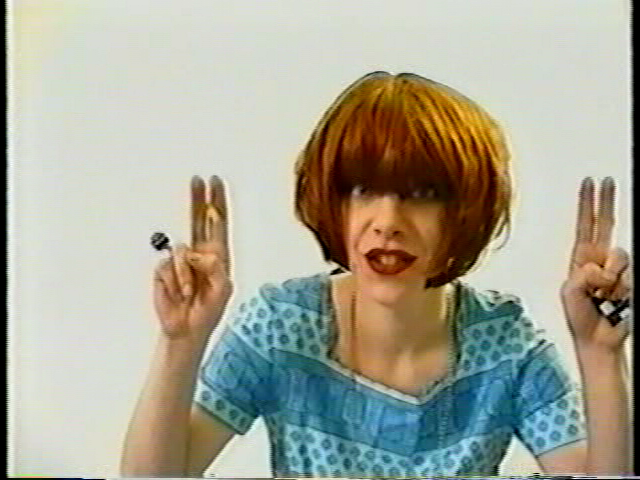
In Untitled Fall '95, Bag, at the time an art student, "plays" Bag the art student. In a series of deadpan performances, Bag gathers fragments of pop detritus, fashioning a thoroughly mediated document that is at once a celebration and a record of loss. With the narrative inevitability of a TV serial, the eight diaristic segments trace a woman's struggle to make sense of her experience at art school. As each installment marks the start of a new semester, Bag's character addresses the camera with her latest observations and frustrations.

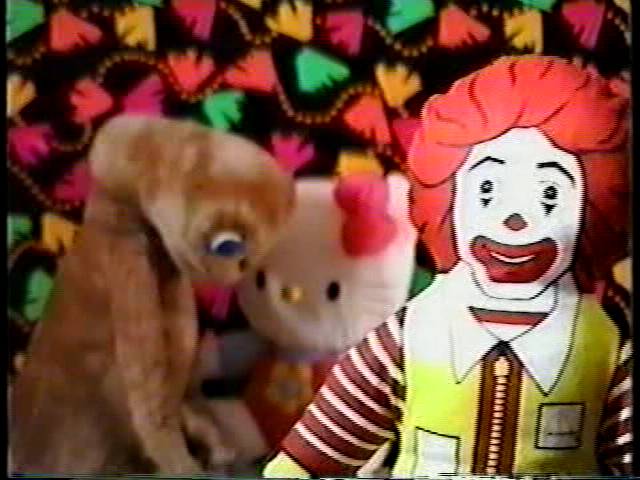
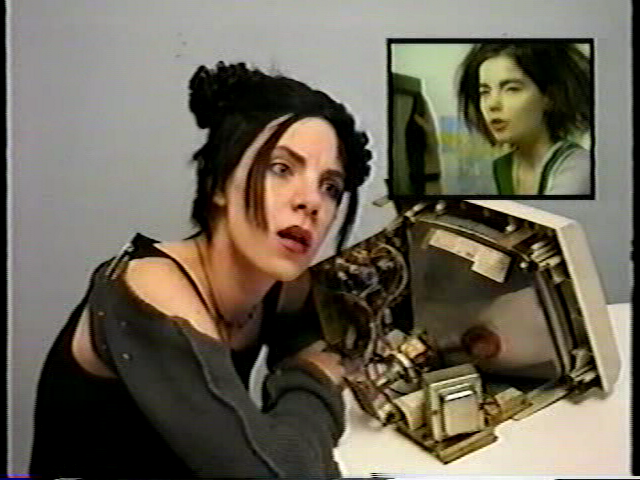
Interspersed between these confessions are eight set-pieces, in which Bag performs scenes from the background noise of her imagination: a pretentious visiting artist, London shop-girls discussing their punk band, a Ronald MacDonald puppet attempting to pick up a Hello Kitty doll, the singer Bjork explaining how television works. These surreal episodes sketch out what Bag sees as the simultaneous attraction and repulsion of contemporary youth culture, and teeter on the divide between parody and complicity.

What emerges is a picture of anxiety, boredom, and ambivalence. As Bag despairs at one point, her culture is being sold back to her. However, popular culture, enmeshed with fashion, music, and the art world, necessarily depends on the machinations of capitalism. How does one mount a successful critique, when irony, satire and subversion have been enshrined by advertising and the popular imagination?

Download this at KaraGarga.

at 8:35 PM  

Omer Fast - Omer Fast: Demo Disk, Extracts from four videos (2001 - 2003)

Download this at KaraGarga.

A Tank Translated (excerpts) 2002
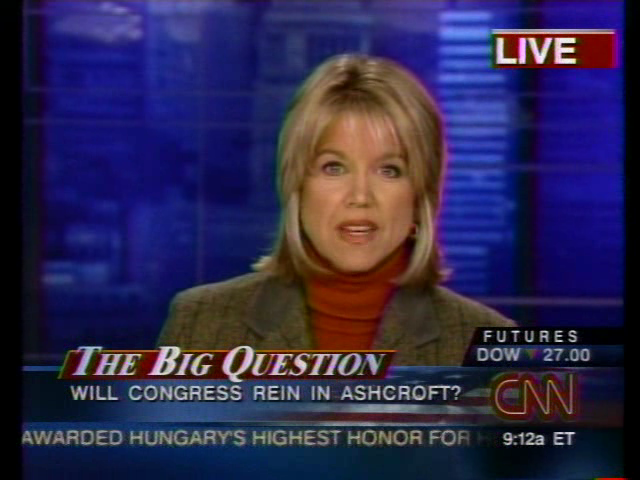
CNN Concatenated 2002
T3 - Aeon 2001
Spielberg's List 2003

From WHITNEY BIENNIAL
Born 1972 in Jerusalem, Israel; lives in Berlin, Germany

Omer Fast works with film, video, and television footage to examine how individuals and histories interact with each other in narrative. He mixes sound and image into stories that often veer between the personal and the media’s account of current events and history.

For Spielberg’s List (2003), a 65-minute, twochannel color video installation, the artist visited Cracow, the Polish city that served as the setting for Steven Spielberg’s film Schindler’s List (1993), and interviewed Poles who worked as extras in the film. Their memories are presented as the dry, authentic accounts of a historical event—in most cases, the 1990s Hollywood production, but in some cases the 1940s German occupation. The artist juxtaposes these accounts with shots of the surviving film set, built near the remains of the actual German labor camp and never fully dismantled. Much like the two sites, which appear increasingly indistinguishable with the passage of time, the work reveals the production of history through the merger of recreation and relic.

In Godville (2005), a 51-minute, two-channel color video, historical reenactors at the Colonial Williamsburg living-history museum in Virginia describe their eighteenth-century characters’ lives and their personal lives in ways that seem interchangeable. Fast splices the reenacted and real biographies together, often word-byword, into a rambling narrative that is as aurally fluent as it is temporally dissonant. The work tells the story of a town in America whose residents are unmoored, floating somewhere between the past and the present, between revolution and reenactment, between fiction and life.

Fast’s recent work The Casting (2007), a shorter four-channel video projection, addresses current events. A U.S. Army sergeant recounts two incidents: a romantic liaison with a young German woman who mutilates herself and the accidental shooting of an Iraqi. The two tales are seamlessly woven together into a script that was given to actors to perform in silent tableaux. While the actors try hard to keep still, the narrator’s recollections slip between setting and story, trying to find relief if not redemption in the act of recalling. JASON EDWARD KAUFMAN
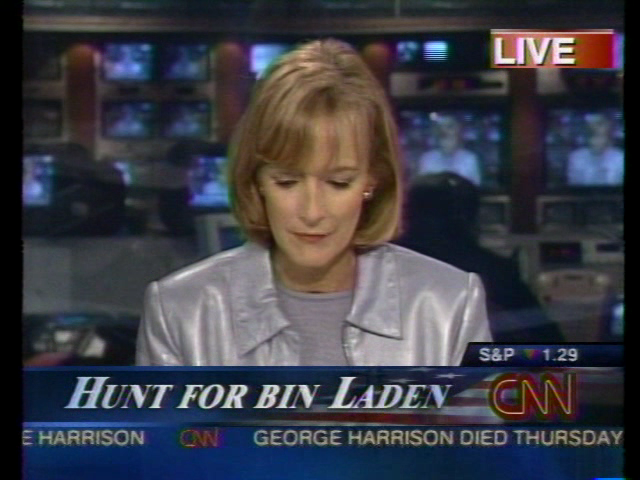
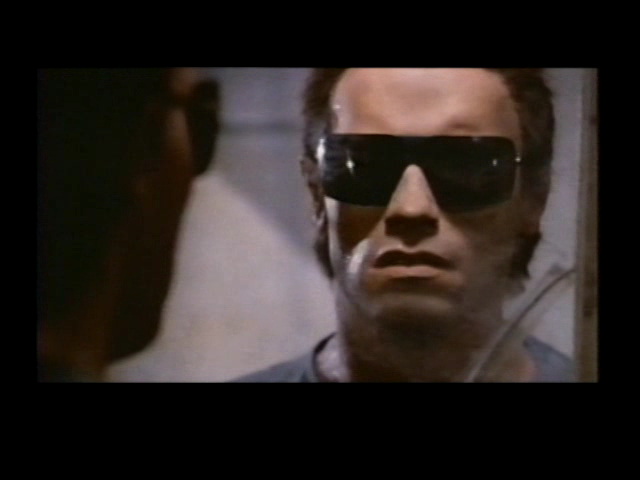
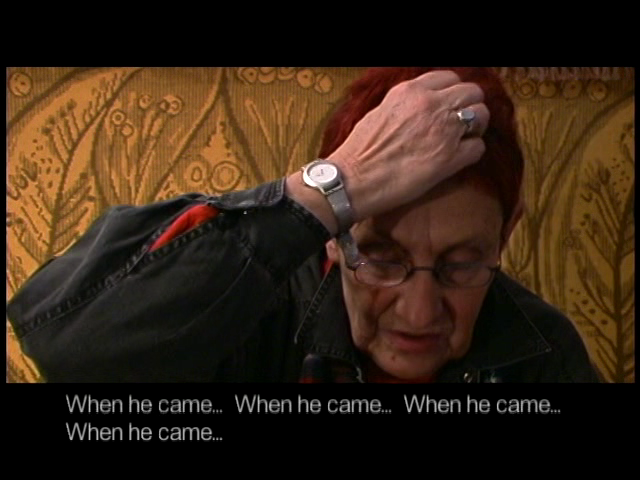
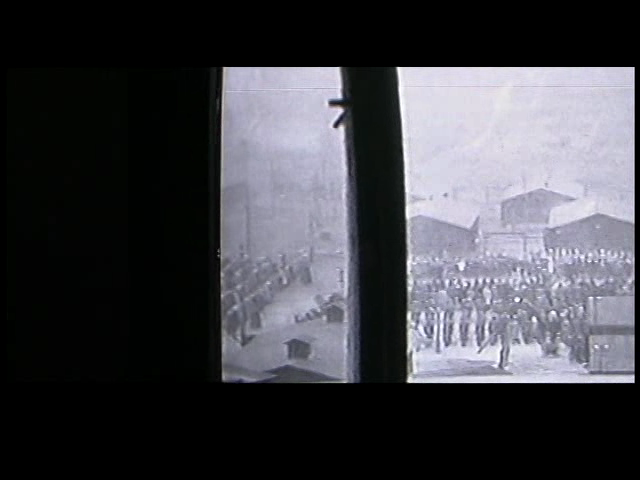

Openings: Omer Fast - showings of video installations by Omer Fast - Critical Essay
Jennifer Allen

Omer Fast really knows how to wreck a movie. His video installations--which may take their cue, if not their footage, from Hollywood fare--tend to unsettle the elements that make moving pictures move, from the sound to the subtitles. For an early intervention, T3-AEON, 2000, Fast smuggled his own tales into the sound track of The Terminator (1984) and returned the tainted videos to rental stores around New York. As the Terminator pulls the trigger on a victim, a male voice-over suddenly interrupts the scene with a recollection of being disciplined as a child by his father: "He slapped me. And then he slapped me again and again." While transforming the blockbuster film into a public archive for private memories, the parasitic narrative frustrates both the hero's actions and the viewer's pleasure.

"I try to resist catharsis in film," says Fast, whom many will remember from the 2002 Whitney Biennial as the sound-effects man in the two-channel video installation Glendive Foley, 2000. "Catharsis involves a kind of movie-house communion where the individual melds into the mass." The American-Israeli artist, who moved between the two countries before completing his MFA at Hunter College, CUNY, seems to set his own experience of dislocation against the unifying power of the screen. In Fast's work, there is no simple identification with a story on a screen, let alone a place, language, or culture. Indeed, Glendive Foley presents a tour through Glendive, Montana, on one monitor and, on the other, the artist frantically trying to mimic the language of the land--not English but a polyphony of suburban sounds, from bugs to lawnmowers.

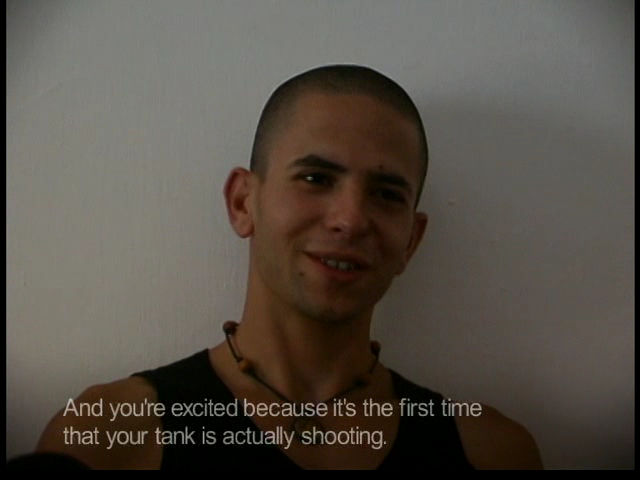
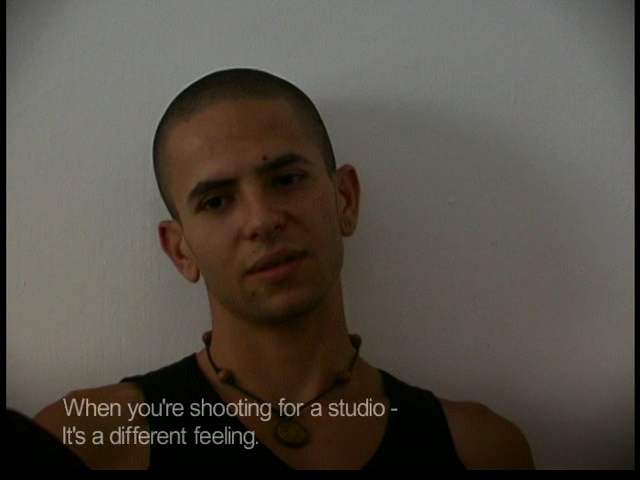
A Tank Translated, 2002, which was shown this spring at the Frankfurter Kunstverein, the Witte de With in Rotterdam, and Postmasters, New York, disrupts the process of identification with faulty translations. Returning to his native Jerusalem, Fast interviewed Israelis who did their military service together in a tank. The commander, gunner, loader, and driver appear on four separate monitors arranged in the same positions that the soldiers took when operating the tank in the Gaza Strip. As the young men relate their experiences in Hebrew, the English subtitles change, transporting us from the battlefront to innocent scenes of male bravado. As the loader boasts about shooting, the word "shells" in the subtitle is abruptly replaced by the word "stunts," and the army recruit becomes a rising movie star. While effecting a metamorphosis, Fast's stuttering subtitles point to other moments in the Israeli-Palestinian conflict where less conspicuous errors of translation may occur: from the civilian to the soldier, from the occupied territories to the television set, from a war zone to the art world.

Displacement also marks Berlin-Hura, 2002, the video that Fast made after moving from New York to Berlin last year. Delving into family history, the artist interviewed his grandmother, who fled Berlin for Palestine in 1936 to escape the Nazi persecution of the Jews. Her family abandoned its flat in Berlin Mitte for what turned out to be an unusable plot of land in the Negev Desert, occupied by nomadic Bedouin tribes. in addition to filming his grandmother, Fast hired an elderly male actor to tell the same story using her exact words. The work, which was shown at BuroFriedrich in Berlin and &: gb agency in Paris, is remarkably edited over four monitors. As the two echoing narrators move through history and geography, their words are punctuated with contemporary views of places they revive by memory: an empty plot where the apartment once stood in Oranierburgerstrasse, the open desert at Hura, a housing block in Tel Aviv. But it's not clear to the viewer whose memories are based on a lived experience and whose come from a script. Like the land, the story appears to be real, but no one can say who owns it. Fast's multiple layers unsettle the veracity of the documentary genre, but he edits footage in a way that manifests the experience of dispossession: A Berlin tram can be heard before it appears on the screen that the grandmother inhabits--that is, before it takes over her story. With its many moving parts, Berlin-Hura underscores the problems of passing on a cultural heritage for those who have a portable history, whether by force or by choice.

Fast's manipulations may seem heavy-handed. But by frustrating our desire to invest in a story, his disruptions serve as a potent reminder that we are indeed looking. Far from confusing the fake and the real, Fast lends a visibility and a material presence to elements in a film that are typically taken for granted. Thus, his shifting subtitles are not so much falsified as "sculpted" in a way that plays on the optical unconscious. Here, looking is not neutral; every eye is haunted by what it has seen in the past. Watching A Tank Translated, spectators must realign their own sights and thus experience the visual dislocation that the men endure as they tell Fast, in the comfort of their own homes, what they saw as soldiers in Gaza.

The notion of the witness--in its historical weight and complexity--figures predominantly in Fast's most recent work, Spielberg's List, 2003, which debuted at Postmasters last spring. Giving a voice to another silent presence in film, Fast traveled to Krakow and interviewed Polish extras who played Jews and Nazis in Steven Spielberg's 1993 Schindler's List. In the two-channel installation, it becomes clear that the extras witnessed not only the film but also the real atrocity. As Fast combines their testimonies with scenes from the film, the set, and the city, history itself begins to stammer with visual slips of the tongue. A woman describes the "selection" process, at pains to explain why she was picked to play a Jewish prisoner; the street corner where the selection took place becomes a strange historical monument, at once banal and grotesque. An elderly man remembers looking at the work camp on his walks, but we're not sure if it's the real camp, which still exists as a ruin, or the film set, which Spielberg left behind. Again, it's not a question of fakes and reals; rather, the act of looking--whether at a camp or at the movies--creates its own history, accumulative, constitutive, forgetful, repressive. Exploring the cottage industry that serves American tourists who come to see the set, Fast demonstrates that Schindler's List has as much drawing power as the event it portrays. Here, Fast's layers of looking add up to a disturbing conclusion: The gaze can even repress the site of genocide and turn it into something magical, sublime. An extra puts it best. After describing the brutality of the counterfeit camp, she sighs, "These are beautiful scenes for me."
Jennifer Alien is an art writer based in Berlin.

Download this at KaraGarga.

at 10:27 AM  

Michael Snow - Breakfast (Table Top Dolly) (1976)

Download this at KaraGarga.


The final film Breakfast (Table Top Dolly) (1972-6, 17 mins) responds to Wavelength - as the forward motion of the camera destroys a crammed breakfast table.

Download this at KaraGarga.

at 3:53 PM  

Michael Snow - WVLNT (1967/2003)

Download this at KaraGarga.


(Wavelength For Those Who Don't Have The Time Originally 45 minutes Now 15!! )
a new DVD by Michael Snow.
Wavelength has been acclaimed as a classic of Avant-Garde filmmaking since its appearance in 1967.
In February 2003 Snow created a new work consisting of simultaneities rather than the sequential progressions of the original work. WVLNT is composed of 3 unaltered superimpositions of sound and picture.
Art Metropole, Toronto, Canada.

“WAVELENGTH is without precedent in the purity of its confrontation with the essence of cinema: the relationships between illusion and fact, space and time, subject and object. It is the first post-Warhol, post-Minimal movie; one of the few films to engage those higher conceptual orders which occupy modern painting and sculpture. It has rightly been described as a “triumph of contemplative cinema”
Gene Youngblood, L.A. Free Press, 1968

Michael Snow

«Wavelength»

With his film «Wavelength,» Michael Snow revolutionized the international Avant-garde film scene like no other production. Viewed from its basic concept, this is a purely «formal» film: it consists of a single, 45-minute-long tracking shot through the length of a room, accompanied by slowly-increasing sine tones.[...] As the camera moves forward through the room’s space (when carefully studied the movement is not continuous, but made up of individual passages edited together), one registers the passing of several nights and days. The camera is ultimately moving toward a spot between two windows at the back of the room, where a photograph on the wall shows the unsettled surface of the sea; in the end, the camera comes so close to it that only the waves fill the screen.
The fascination of this film can be explained through the application of the formal principle of the tracking shot, which seems to determine the entire film, with stray elements of reality: people occasionally appear in the frame; the telephone rings; apparently someone is even murdered in this space. Even what one can recognize of the street through the windowpane constitutes a counter-element to a purely «abstract» form.
«Wavelength ranks among those films which force viewers, regardless of how they react, to carefully consider the essence of the medium and, just as unavoidably, reality,» wrote the critic Amos Vogel.
(Source: Ulrich Gregor, Geschichte des Films ab 1960, Reinbek, 1983.)

Download this at
KaraGarga.

at 3:51 PM  

Michael Snow - digitalSnow (2002)

Download this at KaraGarga.


The opening interface is an excerpt from a sequence in Rameau’s Nephew by Diderot (Thanx to Dennis Young) by Wilma Schoen (1974) - a fifteen-minute sequence from which key frames have been extracted. In showing the tools that Michael Snow uses, the sequence demonstrates a particular dimension of the artist’s work, which incorporates various materials and media. It also explores possible links between perception and different means of transmitting perception, notably language and technology (in this instance cinema and photography). The objects placed on this table, continually moved by the artist, will act as gateways into the database of the artist’s work and, depending on the grouping, will take you to different sections of the DVD.
Sections and elements of the DVD:
* 4800 entries in the database
* 799 documented works
* 60 film or video excerpts
* 57 texts on the artist
* More than 40 soundtracks: sound pieces, jam sessions from Snow and the CCMC
* 6 main interfaces
* Texts from the artist
* Notes and drawings from the artist
* Animation and simulation installations in 2D/3D
* Reproductions of photographic works
* Bibliography, directories and search tools (databases)
Other film excerpts:
* Telescope 70: Snow in Venice: Canadian Broadcasting Corporation, TV Archives, Toronto
* Toronto Jazz: réalisation Don Owen, 1963, Office national du film du Canada, Montréal
* Snowblind: réalisation Hollis Frampton, 1968

Download this at KaraGarga.

at 3:50 PM  

Michael Snow - To Lavoisier, Who Died in the Reign of Terror (1991)

Download this at KaraGarga.


To Lavoisier Who Died in the Reign of Terror (1991) is a collaboration with filmmaker Carl Brown, who specializes in homebrewed chemical film development. In a series of tableaux, people perform everyday tasks — sleeping, dining, reading, card-playing — as the camera arcs past and over them (the replete set of positions recalls La région centrale’s movements). Brown abraded the film stock, creating a continuous dynamic surface-effect tension with the comparatively static views and cueing the soundtrack, the crackle of fire. The physics and chemistry of combustion were the scientific focus of Lavoisier, the 18th-century savant.

Download this at KaraGarga.

at 3:49 PM  

Michael Snow - So Is This (1982)

Download this at KaraGarga.


"SO IS THIS parlays an elegantly simple concept into an unpredictable, cumulatively rich experience.

"The film is a text in which each shot is a single word, tightly-framed white letters against a black background. Compared to Snow's recent epics ... it seems almost a throwaway but it's also the most satisfying film he's made in a decade ....

"With formalist belligerence, SO IS THIS threatens to make its viewers 'laugh cry and change society,' even promising to get 'confessional.' Although the film does reflect Snow's personality - his Canadian-ness, preference for humor over irony, obsession with art world chronology (who did what first) - its only confession is the tacit acknowledgement that he's sensitive to criticism. Snow takes full advantage of his film's system of discourse to twit restless audiences .ƒ A lot of this is pretty funny but SO IS THIS is more than a series of gags. Snow manages to defamiliarize both film and language, creating a kind of moving concrete poetry while throwing a monkey wrench into a theoretical debate (is film a language?) that has been going on sporadically for 60 years.

"If you let it, Snow's film stretches your definition of what film is - that's cinema and SO IS THIS." - J. Hoberman, The Village Voice

Download this at KaraGarga.

at 3:47 PM  

Michael Snow - Presents (1981)

Download this at KaraGarga.

A film by Michael Snow with Jane Fellowes and Peter Melnick, and with Robin Collyer, Keith Lock, Brian Day, Stephen Smith, Gregory Svaluto, Ric Amis and The Canada Council.

Michael Snow (Toronto, 1929) is considered one of Canada’s most important living artists. A prolific painter, photographer, sculptor, jazz musician and filmmaker, Snow’s art explores the possibilities inherent in different mediums and practices. He has received many international awards, and his work is shown continually in retrospectives around the world. With each piece, Snow invites us to contemplate and put into question his chosen medium, in an oscillation between what is represented, its process and material. “The apparent vertical scratch in celluloid that opens Presents literally opens into a film within the film. When its figure awakens into a woman in a ‘real’ unreal set, the slapstick satire of structural film begins. It is not the camera that moves, but the whole set, in this first of three material ‘investigations’ of camera movement. In the second, the camera literally invades the set; a plexiglass sheet in front of the dolly crushes everything in its sight as it zooms through space. Finally, this monster of formalism pushes through the wall of the set and the film cuts to a series of rapidly edited shots as the camera zigzags over lines of force and moving fields of vision in an approximation of the eye in nature. Snow pushes us into acceptance of present moments of vision, but the single drum beat that coincides with each edit in this elegiac section announces each moment of life’s irreversible disappearance.” Philip Monk, Art Express


Download this at KaraGarga.

at 3:44 PM  

Michael Snow - La Région Centrale (1971)

Download this at KaraGarga.
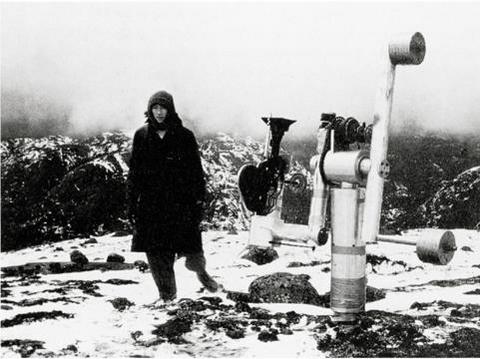


«La Région Centrale» was made during five days of shooting on a deserted mountain top in North Quebec. During the shooting, the vertical and horizontal alignment as well as the tracking speed were all determined by the camera’s settings. Anchored to a tripod, the camera turned a complete 360 degrees, craned itself skyward, and circled in all directions. Because of the unconventional camera movement, the result was more than merely a film that documented the film location’s landscape. Surpassing that, this became a film expressing as its themes the cosmic relationships of space and time. Cataloged here were the raw images of a mountain existence, plunged (at that time) in its distance from civilization, embedded in cosmic cycles of light and darkness, warmth and cold.


La Région Centrale (Quebec, 1971, 180 min., 16mm, color) is arguably the most spectacular experimental film made anywhere in the world, and for John W. Locke, writing in Artforum in 1973, it was “as fine and important a film as I have ever seen.” If ever the term “metaphor on vision” needed to be applied to a film it should be to this one. Following Wavelength, Michael Snow continued to explore camera/frame movement and its relationships with space and time in Standard Time (1967) an eight minute series of pans and tilts in an apartment living room and (Back and Forth) (1968–69), a more extended analysis. But with La Région Centrale, Snow managed to create moving images that heretofore could no possibly be observed by the human eye. For this project he enlisted the help of Pierre Abaloos to design and build a machine which would allow the camera to move smoothly about a number of different axes at various speeds, while supported by a short column, where the lens of the camera could pass within inches of the ground and zoom into the infinity of the sky. Snow placed his device on a peak near Sept Îsles in Quebec’s région centrale and programmed it to provide a series of continuously changing views of the landscape. Initially, the camera pans through 360° passes which map out the terrain, and then it begins to provide progressively stranger views (on its side, upside down) through circular and back-and-forth motions.

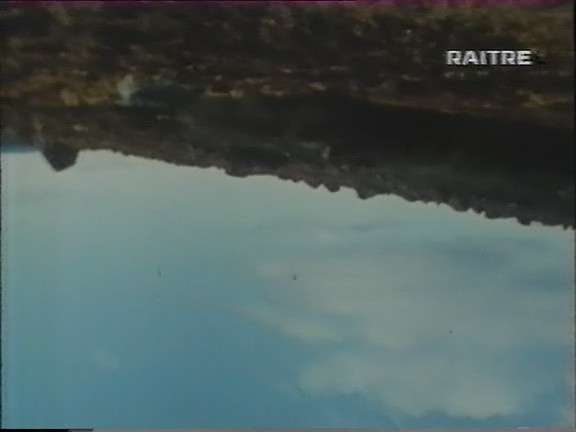
The weird soundtrack was constructed from the electronic sounds of the programmed controls which are sometimes in synch with the changing framing on screen and sometimes not. Here, allusions to other films occur, especially science fiction works like Stanley Kubrick’s 2001: A Space Odyssey (1968) which similarly reveals a barren, human-less primal landscape (with odd sounds) and spatially disorients the spectator. In La Région Centrale’s second hour, the world is inverted for so long, that when the camera swings vertically through a full circle to restore the horizon line to its rightful position, above the earth, it looks wrong. In the complete absence of human or animal forms, one can imagine the outlines of animals in the silhouetted shapes of rocks at twilight. It is impossible not to notice “camera movement” in this film, and, as Locke notes, one is inclined to observe the frame edge leading the movement (rather than the center) much of the time.

I can only imagine what it would have been like to see La Région Centrale, captivated in the extreme dark and quiet of New York’s Anthology Film Archive theater built specifically for the screening of experimental films in the 1970s. But, in any event, seen under any condition, the last hour offers up an incredible experience, with unbelievably high speed twisting and swirling motions rendering dynamic color and line abstractions. Finally, by rephotography —of the film jumping out of the gate— and flaring out of the image to red and yellow colors, and, closing with the camera apparently motionless on the sun, Snow presents a reflexive impression of the camera as the ultimate transformative, creative apparatus, capable of any magic. La Région Centrale presents a definitive “metaphor on vision.”


Download this at KaraGarga.

at 3:41 PM  

Michael Snow - Back and Forth (1969)

Download this at KaraGarga.

"This neat, finely tuned, hypersensitive film examines the outside and inside of a banal prefab classroom, stares at an asymmetrical space so undistinguished that it's hard to believe the whole movie is confined to it, and has this neck-jerking camera gimmick that hits a wooden stop arm at each end of its swing. Basically it's a perpetual motion film that ingeniously builds a sculptural effect by insisting on time-motion to the point where the camera's swinging arcs and white wall field assume the hardness, the dimensions of a concrete beam. "In such a hard, drilling work, the wooden clap sounds are a terrific invention, and, as much as any single element, create the sculpture. Seeming to thrust the image outward off the screen, these clap effects are timed like a metronome, sometimes occurring with torrential frequency." - Manny Farber, Artforum, 1970


Download this at KaraGarga.

at 3:39 PM  

Ryoji Ikeda - C4I and formula [ver 2.2] (2004)

Download this at KaraGarga.

This is a recording of Ikeda's concert of C4I and formula [ver 2.2] given on the 13 february 2004 at YCAM, Yamaguchi in Japan. It was the world premiere concert for the work C4I. This is from a press-release by forma in UK they released the booklet and DVD formula that you can find here link (note that I think this will never have a general release as I have had this DVD for three years without seeing any actual release)

C4I is 37 minutes long and contained on the first DVD.

formula [ver 2.2] is 40 minutes and contained on the second DVD.


Download this at KaraGarga.

at 11:58 AM  

Ryoji Ikeda - Formula (2005)

Download this at KaraGarga.

This untouched DVD upload is aimed at fans of Ryoji Ikeda, or, extremekly unlikely as it might seem, individuals who enjoy minimalist electronic compositions/constructions but somehow aren't familiar with Ikeda. The content here is not the IDM side of Ikeda but is squarely the electro-minimalist composer and installation artist Ikeda.

There are two parts to this DVD. The first part is audio tracks only, with no visuals (about 30 min.) and the second part is audio and visuals, a filmed installation by Ikeda done in 2001 (about 35 min.). Details below in the tracklisting.

I think it is Ikeda at his best, at least the Ikeda I like best, especially the sound & image portion of the DVD. In that section, at times the images are very minimal, fittingly so, but at other times there is a lot going on and going on rather quickly so that multiple viewings are rewarded.

The content of the DVD is exclusive to this release, which is from 2005, in a numbered, limited edition of 3000. It was originally released in 2002 apparently.


Japan's leading electronic composer Ryoji Ikeda focuses on the minutiae of ultrasonics, frequencies and the essential characteristics of sound itself. His work exploits sound's physical property, its causality with human perception and mathematical dianoia as music, time and space. Using computer and digital technology to the utmost limit, Ikeda has been developing particular "microscopic" methods for sound engineering and composition. Since 1995 he has been intensely active in sound art through concerts, installations and recordings.


Tracklisting:

Tracks 1 to 8 are Stereo and Dolby AC-3 soundtracks without visual images.
Tracks 9 to 19 are stereo soundtracks with visual images.

Installations (Extracts) (29:18)


1 0°: CBK Villa Alckmaer, Rotterdam, 1998 (1:02)
2 Matrix (For Acoustic Dislocation): The Mind Zone Of The
Millennium Dome, London, 2000 (3:01)
3 Matrix (For An Echoic Room): ICC, Tokyo, 2000 (4:38)
4 A: Hayward Gallery, London, 2000 (5:01)
5 Spectra: MicaMoca, Milano, 2001 (5:03)
6 Matrix (For Container): Centraal Museum, Utrecht, 2001 (4:33)
7 Spectra II; Schirn Kunsthalle, Frankfurt, 2002 (3:03)
8 Db: ICC, Tokyo, 2002 (2:52)


Concert. Formula [Prototype] At The Garden Hall Yebisu, Tokyo, October 14, 2001 (36:19)


9 Intro (2:43)
10 Headphonics 0/0 (4:47)
11 Headphonics 1/0 (3:11)
12 Headphonics 0/1 (4:09)
13 +../- (5:06)
14 Testone + Trans-missions (0:15)
15 Time 1'11" (1:10)
16 Time 3'33" (3:31)
17 Time 4'44" (2:24)
18 .Matrix 1000000000 (3:28)
19 Zero Degrees [3] (5:30)

Download this at
KaraGarga.

at 11:53 AM  

German Federal Cultural Foundation - 40 Years of Video Art, Vol 1 (1963-1969)

Download this at KaraGarga.

DVD STUDY EDITION - DISK 1 OF 12

A panorama of video art produced in Germany with more than 28 hours of historic as well as current works by 59 artists, distributed as a box of 12 DVD.

In the summer of 2004, a jury (Dieter Daniels, Rudolf Frieling, Susanne Gaensheimer, Søren Grammel, Wulf Herzogenrath, Nan Hoover, and Doris Krystof) compiled an exemplary selection of works, a panorama of 59 historic but also current works ranging from 1963 up to the present. This initial, overview-oriented selection will now travel as an archive to several locations in a concerted action, exhibited at the same time by the five participating museums. Apart from this, each museum presents its own focal point as an expansion and contextualizing of these videotapes. The spectrum of these exhibitions embraces the "1960s" (Bremen), the "1980s" (Düsseldorf) as well as the present "Update.06" (Munich). Handled at two locations is a "Revision" of the selection – in light of the chosen artists from the former GDR (Leipzig), and with regard to the existing collection of Video Art and restoration practices (Karlsruhe). From the standpoints of form and content, this allows the concert of thematic focal points to investigate the conditions of an historic and present-day exhibiting potential and the relevance of Video Art.

Two publications are accompanying this initiative-project of the Kulturstiftung des Bundes: a comprehensive, full-color catalog edited by Rudolf Frieling and Wulf Herzogenrath, and published by Hatje Cantz Verlag, which includes excerpts of all the works on a DVD-ROM; for copyright reasons, the DVD Study Edition, including all the works in their full length, is only available to institutions in the fields of education, teaching, and research.

Disk 1 of 12 contents:
1963 - SUN IN YOUR HEAD - WOLF VOSTELL - [5'17"]
1965 - FILM-MONTAGEN I-III - PETER ROEHR - [23'55"]
1965/66 - HE JOE - SAMUEL BECKETT - [33'54"]
1968/69 - BLACK GATE COLOGNE - OTTO PIENE / ALDO TAMBELLINI - [47'02"]
1968/69 - TV AS A FIREPLACE - JAN DIBBETS - [22'07"]
1969 - LAND ART (JAN DIBBETS: 12 HOURS TIDE OBJECT WITH CORRECTION OF PERSPECTIVE, 7'35") - GERRY SCHUM - [31'56"]

These two images, above/below, are just to show the difference between the old Sun in Your Head available on the Fluxus Film Compilation and this new restoration.


Download this at KaraGarga.

at 1:23 AM  

Tacita Dean - Kodak (2006)

Download this at KaraGarga.

After discovering that the Kodak factory in Chalon-sur-Saône, France, was closing its film production facility, Dean obtained permission to document the manufacture of film at the factory with the soon-to-be obsolete medium itself. The 44-minute-long work Kodak constitutes a meditative elegy for the approaching demise of a medium specific to Dean’s own practice. Kodak’s narrative follows the making of the celluloid as it runs through several miles of machinery. On the day of filming, the factory also ran a test through the system with brown paper, providing a rare opportunity to see the facilities fully illuminated, without the darkness needed to prevent exposure.


Download this at KaraGarga.

at 7:27 PM  

Yang Fudong - Seven Intellectuals In Bamboo Forest (2003)

Download this at KaraGarga.

In one of my earlier works, the photographic triptych The First Intellectual, I touched on a concept that still preoccupies me: One wants to accomplish big things, but in the end it doesn't happen. Every educated Chinese person is very ambitious, and obviously there are obstacles--obstacles coming either from "out there," meaning society or history, or from "inside," from within oneself. In this work you could see that "the first intellectual" has been wounded. He has blood running down his face and wants to respond, but he doesn't know at whom he should throw his brick; he doesn't know if the problem stems from himself or society. Ideals and the way they distinguish people, but also the way that they can unite people and encourage them to form bands, partnerships, brotherhoods--this was something I wanted to investigate in more depth, taking my time to do so. When I eventually completed An Estranged Paradise, I started defining this new, vast project, which will untold as five different films. Because I feel that this topic is extremely important to an understanding of China, both past and present, I wanted to articulate several temporalities together: one that is really ancient, the stories of "The Seven Sages of the Bamboo Grove"; another set during the '50s and '60s, when there was a profound questioning of the status and role of intellectuals (and so the films will have a clear '50s, '60s kind of New Cinema flavor); and, ultimately, one dealing with the concerns and ideals of today.

The Seven Sages of the Bamboo Grove were a group of Chinese scholars and poets who fled the troubles accompanying the transition between China's Wei and Jin dynasties during the mid-third century. They assembled in a bamboo grove, where they forgot all of their worldly troubles, losing themselves in pure thought and discussion. This sort of retreat was typical of the Taoist-oriented ch'ing-t'an ("pure conversation") movement, which advocated freedom of individual expression and hedonistic escape from extremely corrupt politics. Their ideal consisted of following their impulses and acting spontaneously, and being sensitive to the beauties of nature.

So the first film in this project stands for me like the beginning of a book, the preface; it's an introduction of the story and the fate of these "new" seven intellectuals. "The Seven Sages of the Bamboo Grove" doesn't exist as a book; there are legends, popular stories, hearsay knowledge, and, of course, what's interesting is also the distortion, the fact that the stories have continually been adapted to changing contexts and times and to the intentions of different storytellers. That's also something that I want to investigate, in light of contemporary China and its relationship to history--this state we're in, which can be described as a moment when we have to negotiate our past while imagining our present.

The first film shows the intellectuals traveling to and dwelling on Huangshan, a very famous mountain situated in the southern part of Anhui Province. The landscape, the nature, is just beautiful there. The peaks rise one on top of another, and the pines and cypresses are luxuriantly green. There are almost a hundred big and small peaks and ridges, and plenty of lakes, brooks, deep pools: It's a kind of dreamscape. I really like showing this sort of atmosphere--very calm, very beautiful, but with a strange, disturbing aspect, exactly like in a dream. Or like when you wake and you cannot accurately recall the dream. Still, a feeling lingers that you had a strange or even frightening dream, and you know if you try to describe it to someone else, that person just won't be able to relate; you can only keep it inside you. In our real life, it seems that where we are heading is always the opposite of where we want to go. It is the same with the dream. We are dreaming we are somewhere, but when we wake up, we find that we are somewhere else. Perhaps this reflects the perfection of the dream.

My new film investigates how this dreamlike environment affects relationships and discussions among the intellectuals--as well as their solitary meditations on individuality and liberty. We need to pursue something, and then we have our spiritual sustenance and belief. In the subsequent films, the intellectuals will be shown living in a building, in a metropolis--say, Shanghai; in a village in the countryside in the company of peasants and villagers; and on a deserted island where they'll start to invent a new world from scratch by defining new modalities of social life and interaction and a new distribution of labor. (Of course, the separation of material and immaterial labor and capital will be questioned.) And in the fifth and last part, eventually the intellectuals will return to the city--and so return to reality, confronting their contemporaries with their new experiences.

At the 50th Venice Biennale, Shanghai-based artist Yang Fudong presented The Seven Intellectuals M Bamboo Forest, 2003, the first part of his new filmic pentalogy, The Seven Intellectuals, an adaptation of the traditional Chinese stories known as "The Seven Sages of the Bamboo Grove." The first Installment (shot in 35 mm black and white) begins the series' exploration of the ambiguous position of intellectuals in contemporary China--their longing for individual freedom in the shifting context of an emerging capitalist economy. Yang, who was born in 1971 in Beijing and graduated from the China Academy of Fine Arts, Hangzhou, has shown an interest in the conundrums of idealism in his earlier works, such as the photographic triptych The First Intellectual, 2000, where he reflects on the difficulty of finding and adopting a rebellious and critical attitude in a society undergoing changes that are as rapid as they are profound. On other occasions, his approach has been poetic and nostalgic, showing stylistic references to Chinese films of the '30s and '40s, such as Yuan Muzhi's Street Angel (1937) and Fei Mu's Spring in a Small Town (1948). Yang's Internationally praised first feature film, An Estranged Paradise (2002), tells the story of Zhuzi, a young intellectual befallen by a strange illness, a restlessness that arrives with the rainy season and disappears with its end. In Yang's own words, the film stands as "a meditation on life," in which nature seems Intimately bound to psychology. It is a poignant convergence of mind and outside world that presages the first episode of The Seven Intellectuals.


Download this at KaraGarga.

at 7:25 PM  

Brice Dellsperger - Body Double X (2000)

Download this at KaraGarga.

Body Double (X)

Maxime Matray

– C’est pas maintenant que vous sortez votre liqueur médiévale ?
– C’est pas là que vous me traînez par les cheveux jusqu’au lit ?

– You supposed to take out your medieval liquor now
– You supposed to grab my hair and drag me to bed now?

Fabio Testi and Romy Schneider
L’important c’est d’aimer

Life in the gallery of replicas

For several years now,Brice Dellsperger has been an expert in the art of faking in the most blatant respect: he remakes and recycles specific movie scenes. The first episodes of his series of palimpsests, entitled Body Double, add a subversive cosmetic layer to the original sources, turning them inside out and allowing them to span several genres. The source material includes carefully selected pieces from the works of Alfred Hitchcock (Psycho), Brian de Palma (Dressed to Kill, Body Double, Blow Out, Obsession), Georges Lucas (Return of the Jedi), and Gus Van Sant (My Own Private Idaho). However, every last vicissitude of the linear narratives of these films has been meticulously removed, with a nearly surgical care, so that in the end each one of these sequences seems to harbor within itself, and for itself, something immediately archetypal. Though designed as a fictional shortcut, each sequence is always shown outside the boundaries of fiction. Murder scenes – three in total, one by strangulation and others through a wide range of injuries – a love scene set on a romantic seashore, a chase scene set in an amusement park, a homecoming scene set in an airport, a tragic scene with fireworks as a backdrop, a confessional scene with oedipal and incestuous overtones, a night drive set to disco music, and so on. Systematically, the viewer finds that the same cinematic turns consistently allow the filmmaker to attain the same effects. For the sake of the remake, each gesture, each shot, and each expression have been dissected in depth before being brought into play again in a new and synthetic context. Sometimes, the same sequence has been shot and edited several times with different actors. This could indicate the beginnings of a sort of checklist of passions and actions shown in an over-simplified way, for the use of proto-filmmakers and crypto-Hollywood freaks and their emulators. However, in the end, you find yourself in a totally different dimension. Because most of the characters born from Brice Dellsperger’s mind are men wearing wigs, fake boobs, make up, and gaudy women’s apparel. Within the confines of our traditional lexicon, we would name them “transvestites,” which is somewhat of a definition, but still falls short. These characters sometimes play multiple roles, in dialogue with their alter-egos, crowned with incredibly huge masses of fake hair of all hues and shapes. If we ignore the considerable weight of this anecdote, these scenes are often a chance to portray the ideas of otherness and the concept of twins or doubles, and the relationship that each and every one of us has with death, perched atop too high-heels. And indeed, Death often appears like this.

What counts is appreciating the extension

Better say it before someone gives us grief: Body Double (X), opus number 10, has nothing to do with a tribute. It is a palimpsest, a dubbing act; or maybe merely a painting in all its grandeur on a second-hand canvas scavenged from an old garbage can. At its origins, the film is bloody; beginning and ending with scenes of bloodshed. The former is very obviously fake. The latter is, too, (though in a less blatant way), this is, after all, a movie, but if we believe in the veracity of film and its prerogatives, we necessarily believe in the veracity of this cinematic blood. In the space between these two bloody sequences, a complex narrative thread unravels, woven with unsure feelings and vague intensions, business deals and failures. Quite a few failures. Notably, one actress learns to say “I love you.” People die. It is a movie by Andrzej Zulawski, based on Christopher Frank’s novel La nuit américaine, starring Romy Schneider, Fabio Testi, Jacques Dutronc, Klaus Kinski and a few other actors.L’important, ce n’est pas d’aimer le film de Zulawski. What matters is not whether or not you like Zulawski’s film. You can even watch the enhanced version produced by Brice Dellsperger without knowing anything of the original.

Opinions shared with the common people

“No one will believe you if you claim it is a remake”. Indeed, Dellsperger’s films are too far removed from their sources to be considered remakes. Regarding the Body Double series, Brice Dellsperger stated: “Our aim was to empty out the fiction, to drain all the energy from the original movies, so they would become just empty shells.’’ Therefore, each component was traced, re-considered, re-thought and re-shaped separately not so much to meet an independent narrative requirement, but rather to offer the viewer the solidity of a conglomerate composite. This film is a piece of particle board glued together by a cabinet-maker. It is a mongrel dog that has constructed itself from the ground up, legs, back, and hide, then teaching itself its own vocabulary. You always walk better when you start by building your own legs, even when treading on the cast-off limbs of your forebears. This is a well-known fact. There is not a single dog that would dare to refute this. Not even a single dog’s armature.
On a practical level, what Brice Dellsperger does is essentially touch-up work: he applies a slight layer of make-up to the framework using paintbrushes loaded with excess and overflow; which lends the whole piece a brand new hue, rouged cheeks and a bit more formality overall. Sometimes, something reminiscent of the Ancien Régime (still wriggling underneath the water’s surface, as discreet as hot lava) pierces through the cosmetic crust. And this emergence gives life to hills and valleys, as well as many discrepancies, some noises, and a smile. One does not know how to get rid of it; or even if one should get rid of it. Let’s keep it, then, because this sprucing up, and the resulting bumps and creases in the make-up, all converge towards painting and its pointless, modernist pursuit of a smooth, flawless surface. Brice Dellsperger’s method is based on stratification, superposition of shots and collage of vignettes. Resorting to the power of thickness, he exhausts the image so as to transform these layers something abstract. Take a look at the image: its sole purpose seems to be continuing to signify what it has always signified. Poor thing. But it will soon give up as the significance is buried deeper and deeper under each layer. However, it will resurface somewhere else, transformed, worn out and magnified all at once. It resurfaces within the margins, through the presence of these heavily made-up characters showing too much cleavage and perched on excessively high heels.
All these potentially grotesque elements that strike us from the first moments of the film fade away very quickly as the eye becomes accustomed to them. All that remains, then, is the astonishing tipsiness elicited by the formal elements of the film: the flickering of the screen and the inability of the gaze to settle on any real object. That is, on any object other than the figure of the transvestite, vital element in all of Brice Dellsperger’s works, and a figure belonging to no defined dramatic category. Just like the figure of the clown as defined by Christian Baud-Mercier in his Ennui Spectaculaire, the transvestite has this “perfectly measured taste for nearly tragic emphasis, conveyed by face paint, onomatopoeias, and a wide range of provocative gestures […] nobody has asked him for the moon; yet he brings it back anyway. But, as always, it is made out of cardboard.”

What do I look like?

Needless to say, Body Double (X) is a complex and ever-changing fortress, and the machinery behind all this is called Jean-Luc Verna. He plays every single part. His duplicity is made obvious through his many hairpieces and garments, which change at the whim of his characters. One recognizes his arms, his hands dotted with constellations enhancing their smooth and soft appearance.
During the course of the film, he is his only interlocutor, under the weight of his various eclectic hairdos. Sometimes represented by a half-funeral latex mask of his own face, he gives himself his cues. At other times, exploring the far reaches of the vast territory of acting, he speaks to no living creature. Several times he resorts to simultaneous, lip-synched monologues.
Jean-Luc Verna is the nucleus around which revolves the setting of this drama already compromised by others, at an earlier time. Take a look at these tables, these removable carpets, these mobile fireplaces, all playing off the actors’ movements. The bodies move as if they were weightless. Both furniture and people seem permanently caught up in subsidiary torments, in weird, asynchronous states of confusion. In the end, there remains but one distinguishable element: Jean-Luc Verna acting the whole movie for his own sake, for the film’s sake, through and through to its basest elements.

No pictures, please

Andrzej Zulawski’s L’important c’est d’aimer tells the tale of individual cowardice caught within the grander scheme of universal cowardice, and the attempt to sort out one from the other. Amidst rampant conflicts of interest, only one character seems to remain truly lucid: the part played by Michel Robin. Before feverishly climbing upon a table, he tells Servais Mont (played by Fabio Testi): “Come on, let’s be realistic. We’re in the Western world, the solution will be a capitalistic one. How much do you love your cute little actress?” Brice Dellsperger’s adaptation manages to exclude this enlightening scene, in which lies the entire moral core of Zulawski’s film, without compromising his film’s artistic integrity. This is, undoubtedly, because the moral and edifying aspects of Zulawski’s film have, themselves, been annulled. Along with all traces of pathos. Gone with the wind.
The whole “Body Double” series takes root in this very territory. A body double, in English, is someone’s stand-in. But if we look at the concept very literally, as in “two bodies,” it describes so well what it is Brice Dellsperger aims to produce: the impression that there is, thanks to these added cosmetic layers, more than a body. This way, he can – as he recently stated in a Parisian newspaper interview– “lend some texture and roughness to the image”. And vice-versa.


Download this at KaraGarga.

at 7:24 PM  

Richard Serra - Frame (1969)

Download at KaraGarga.

In Frame (1969), Richard Serra emphasizes the disconnect bewteen the real space of the cinema and the illusory space of the screen. We first see Serra's hands methodically measuring and marking the boundaries of the film frame, followed by the projected image of a blank surface whose perimeter is similarly marked. The surface is then moved aside to reveal a window which looks out upon a bustling city street. The In the final stage, Serra interacts with the projected image of the window, remeasuring and remarking its borders.


Download at KaraGarga.

at 7:21 PM  

Dan Graham - Performer/Audience/Mirror (1975)

Download this at KaraGarga.

1975, 22:52 min, b&w, sound Recorded at Video Free America in San Francisco, this work is a phenomenological inquiry into the audience/performer relationship and the notion of subjectivity/objectivity. Graham stands in front of a mirrored wall facing a seated audience; he describes the audience's movements and what they signify. He then turns and describes himself and the audience in the mirror. Graham writes: "Through the use of the mirror the audience is able to instantaneously perceive itself as a public mass (as a unity), offsetting its definition by the performer ('s discourse). The audience sees itself reflected by the mirror instantly while the performer's comments are slightly delayed. First, a person in the audience sees himself 'objectively' ('subjectively') perceived by himself, next he hears himself described 'objectively' ('subjectively') in terms of the performer's perception."


Download this at KaraGarga.

at 6:55 PM  

Roger Beebe - New Maps of the New World (2007)

The entire collection, The Strip Mall Trilogy and Famous Irish Americans.

NEW MAPS OF THE NEW WORLD
experimental shorts by Roger Beebe

As part of his 55-day East Coast tour, filmmaker/programmer/professor/video store owner Roger Beebe will be presenting a program of his short films and videos. These films and videos attempt to marry experimental forms with a documentary interest in a cinema as a means of engaging with pressing issues in our everyday lives. If the works are diverse in subject matter—covering such disparate topics as women in the air force in World War II, the origin of Shaquille O’Neal’s last name, and the horrors (and beauties) of suburban sprawl—and are equally diverse in format—with work in both film (16mm, super 8mm, regular 8mm) and video—they are united by their use of an ironizing poetics to cast a sidelong glance on some often overlooked realities of 20th and 21st Century Americana.

"[Beebe’s films] implicitly and explicitly evoke the work of Robert Frank, Garry Winogrand and Lee Friedlander, all photographers of the atomic age whose Western photographs captured the banalities, cruelties and beauties of imperial America." --David Fellerath, The Independent Weekly

"Beebe's work is goofy, startling, and important." --Daniel Kraus, Wilmington Encore

ABOUT ROGER BEEBE:

Roger Beebe is a professor of Film and Media Studies at the University of Florida. Beebe has screened his films around the globe at such unlikely venues as McMurdo Station in Antarctica and the CBS Jumbotron in Times Square as well as more traditional venues such as the Museum of Modern Art and the Pacific Film Archive in addition to numerous festivals, among them Sundance, the International Film Festival Rotterdam, and New York Underground. He has won dozens of awards including a 2006 Individual Artist Grant from the State of Florida and Best Experimental Film at the 2006 Chicago Underground Film Festival. In addition to his work as a filmmaker, he is also a film programmer: he ran Flicker, a festival of small gauge film in Chapel Hill, NC, from 1997-2000 and is currently Artistic Director of FLEX, the Florida Experimental Film Festival. (If that isn’t enough, he also owns Video Rodeo, an independent video store in Gainesville, FL.)

TB TX DANCE (2006, 16MM, 2 min. 30 sec.)
A cameraless film made in a balck & white laser printer with an optical soundtrack made of dots of varying sizes provides the backdrop for revisiting Toni Basil’s appearance in Bruce Conner’s 1968 film “Breakaway.”

S A V E (2006, 16mm, 5 min.)
A study of a disused gas station provides the occasion for a reflection on our interest in the decaying monuments of mom & pop capitalism. "An elegant, elegiac film…The "SAVE" sign acquires the dignity one ordinarily would assign to an old poplar tree, struggling for life against the ravages of time and the elements." --David Fellerath, The Independent Weekly


(rock/hard place) (2005, 16mm, 6 min. 30 sec.)
Two massive structures—one manmade, the other natural—sit on opposite ends of a causeway in Morro Bay, California, waiting for someone to put them in the same frame.

One Nation under Tommy (2004, DVD installation/digital video, 15 min.)
The telephone game (a.k.a. “grapevine”) gets a new twist as scriptwriters and filmmakers take turns attempting to faithfully reproduce a cynically patriotic Tommy Hilfiger commercial.


Famous Irish Americans (2003, digital video, 8 min.)
A hyperflat exploration of the limitations of our binary thinking about race, featuring appearances by stars of sport & screen. "There just aren't enough films out there like Roger Beebe's 'Famous Irish Americans,' a graphic lecture insisting that black celebrities with Irish last names really are Irish." --Kimberly Chun, SF Bay Guardian
Composition in Red & Yellow (2002, super 8, 2 min. 30 sec.)

A strange homage to Mondrian, featuring McDonald’s restaurants stretching from Gainesville, FL to Oakland, CA, culminating in an appearance by every McD’s in the East Bay. "Astoundingly hilarious" --Matthew Holota, Artvoice (Buffalo)

A Woman, A Mirror (2001, 16mm, 15 min.)
A anti-dance film dance film about gender and technology and the “technologies of gender. “Essential viewing for anyone interested in true visual experimentation.” --John Citrone, Folio Weekly

The Strip Mall Trilogy (2001, super 8, 9 min.)
A look straight into the heart of the most postmodern of architectural forms, the strip mall, shot in a mile-long parking lot that could be Anywhere, USA. “He has actually managed to bust apart the mind-controlling code of relentlessly commercial space and reconfigure it into a landscape of beautiful colors and forms. It is a remarkable piece of Super 8 alchemy." --David Finkelstein, Film Threat


The entire collection, The Strip Mall Trilogy and Famous Irish Americans.

at 10:37 AM  

Noam Toran - Desire Management (2004-2006)

Download this at KaraGarga or buy it directly from the director.

Film shot on 16mm and HD

Desire Management is an installation and film celebrating the use of products as platforms for dissident behaviour. In the project, the domestic space is defined as the last private frontier, a place where alienated people use bespoke appliances to engage in unorthodox experiences. Based on real testimonials and news reports, the objects created attempt to reveal the inherent need for expression and identity formation in the face of conformity. The installation was originally shown at the Venice Architecture Biennale in Summer 2004. The project was commissioned by the CNAC Pompidou as part of the D.Day – Design Aujourd'hui exhibition and was screened at the 2005 Raindance Film Festival. In collaboration with Director of Photography Per Tingleff.


Download this at KaraGarga or buy it directly from the director.

at 10:35 AM  

Michael Snow - *Corpus Callosum (2002)

Download this at KaraGarga.

The corpus callosum is a central region of tissue in the human brain which passes “messages“ between the two hemispheres. Corpus Callosum, the film (or tape, or projected light work), is constructed of, de-picts, creates, examines, presents, consists of, and is, “betweens.“ Between beginning and ending, between “natural“ and “artificial,“ between fiction and fact, between hearing and seeing, between 1956 and 2002. It’s a tragi-comedy of the cinematic variables. Corpus Callosum juxtaposes or counterpoints a realism of normal metamorphosis (two extreme examples: pregnancy, explosions) in believable, “real“ interior spaces with “impossible“ shape changes (some made possible with digital animation). First the camera, then we in the audience, observe the observations of the “real“ people depicted in the obviously staged situations. What we see and what they “see“ is involved in shifting modes of belief. There seem to be (though there is no narrative) a Hero and Heroine. However, from scene to scene they are different people costumed identically or altered electronically. The sound – electronic like the picture – is also a continuous metamorphosis and as the film’s “nervous system,“ is as important to the film as the picture. Or: the sound and the picture are two hemispheres joined by the artist. Corpus Callosum is resolutely “artificial, “ it not only wants to convince, but also to be a perceived pictorial and musical phenomenon.

--Michael Snow


Download this at KaraGarga.

at 10:32 AM  

Michael Snow - Sshtoorrty (2005)

Download this at KaraGarga.

Script, Direction, Design, Sound, Editing, Michael Snow. Actors--Hilda Hashempour, Mac Ebrahimzadeh, Ramin Yazdi. Camera Luc Monpelier. Production Stephanie Markowitz, Jennifer Weiss. Translation, Mani Mazinani. Funding Assistance, The Canada Council

Writing about my films has sometimes discussed the 'narrative' aspect or 'reading' of some of my 'pictorial' nature, which is much more important. Reflecting on this, I realized that I have never wanted to make a purely narrative film, never had and therefore perhaps I should. Perhaps I should finally make a film that really tells a story. Thus 'SSHTOORRTY'.

This can be seen but can it be said? I wrote the script, designed the set, directed the shoot and supervised the sound-mix and edit. The staged action was shot beginning with a camera hold on the apartment's inner doors. A man arrives carrying a wrapped-up painting. He is greeted by a woman. He unwraps the painting, shows it to her. The camera follows them to a central position in the apartment. A dispute develops and the painter smashes the painting he's just brought over the head of the woman's husband. The camera follows the painter and the wife / lover back to the door. He exits, she walks away. There is dialogue, in Farsi, but there are subtitles in English.

The film of the above-described scene was cut exactly in half and the two halves of sound and picture as super-imposed. This makes a simultaneity of actions that occurred 'linearly'. Before and After become a Transparent Now Arrival and Departure are united. It's truly 'filmic', one transparent film over another.

It's a 'painting' about a painting. I was very concerned with the mobile color mixing that would eventually happen. Colors were carefully chosen as I tried to predict how they would mix and interact. I make 'pictures' and the experience of looking at them is more important than the 'elsewhereness' of a story, even in this, my most 'story-telling' film. In that respect, part of the perception or 'reading' of the film involves one's choices of what went before and what came after in the actual pre-filmic event. The use of Farsi and the over-laying of the English subtitles were ways of adding two other layers of complexity. The film was designed to be seen several times, not just once. In my 1974 four-and-a-half-hour film Rameau’s Nephew, I used many different languages. Ones hearing of an unfamiliar language tends the mind toward the ways in which one listens to music. Speech is then more purely sound than sense. Meaning doesn't cancel hearing. A modest political edge: adultery and drinking alcohol can be severely punished in Iran. Part of the original conception was that one could satisfyingly see / hear the episode-on-episode several times. Repeated viewing reduces the strength of the realism and makes it possible for one to see truly the artifact (or, the construct), the artificiality, the art. There are, literally, layers to it and I believe that each time one sees 'it' one sees it differently. One may concentrate for example, on the moving color-mixing, or what happen to the painting or the subtitles, or the way the speech and music are superimposed on each other. And as memory can be questioned, one may question ones memory as to whether each repeat is in fact the same. Were alterations made? The title is of course the word SHORT printed right on top of the word STORY.


Download this at KaraGarga.

at 6:40 PM  

Various - Viva! Italia (2006)

Download this at KaraGarga.

EVA01 VIVA ITALIA!

Over the last ten years electronic images have radically changed not only in the way we perceive them but also in their construction. The integration, inside a common visual matrix of mixed mediums - like video, animation, photography and cinema - have set a visual time very similar to that of reading. Images have, in fact, become almost like blocks of text to be read, thanks to different digital solutions that allow one to scroll forward and
backwards, to stop, and to change the speed of the image. The diversified use of tones and narration levels - trailers, commercials, films, fictions, and documentaries - characterize Italy's current artistic landscape. And from this consideration was born the criteria for the selection process for the works presented in the EVA01 DVD - Boiler Viva! Italia - a criteria that discarded the idea of a compilation of thematic or linguistic characters and opted instead for the concept of an anthology of images in movement.
(Maria Rosa Sossai )


VANESSA BEECROFT - VB48
ELISABETTA BENASSI - UNTITLED SEQUENCE 2003-2004
MONICA BONVICINI - DESTROY SHE SAID
PAOLO CHIASERA - YOUNG DICTATORS' VILLAGE (Trailer)
ROBERTO CUOGHI - GOOD GRIEFIES RELOADED
RA DI MARTINO - NOT 360
LARA FAVARETTO - ON THE AIR
CHRISTIAN FROSI RICCARDO PREVIDI - WE HAVE MET BATMAN
STEFANIA GALEGATI - ORIZZONTE ASSOLUTO DELL’EVENTO
PIERO GOLIA - KILLER SHRIMPS (Trailer)
ARMIN LINKE AMEDEO MARTEGANI - DEVON REX
DOMENICO MANGANO - EURABIA
EVA MARISALDI - BASE
MULTIPLICITY - SOLID SEA 01: THE GHOST SHIP (Extracts)
DIEGO PERRONE - SENZA TITOLO
GRAZIA TODERI - OLYMPIA
PATRICK TUTTOFUOCO - BOING!
FRANCESCO VEZZOLI - OK, THE PRAZ IS RIGHT!


Download this at KaraGarga.

at 6:21 PM  

Paul McCarthy & Mike Kelley - Heidi (1992)

Download this at KaraGarga.

1992, 62:40 min, color, sound

Writes McCarthy: "A collaborative work based on Joanna Spyri's novel, Heidi.. The entire work consisted of a fabricated set, a group of partial and full life-size rubber figures, two large backdrop paintings, and a video tape shot entirely on the set. The set was installed at the center of the gallery (Galerie Krinzinger, Vienna). The set consisted of a chalet at one end, and at the other end the facade of the American bar in Vienna and a bedroom. The set itself maintains its presence as a sculpture.... The figures, props and other items used in the production of the tape, in conjunction with the set, are to be seen as a whole and as works of art, rather than an accumulation of leftovers. We were interested in imitating film and television production, and exaggerating the fractured process of film.


The intention was to create convoluted associations between Heidi, the purity myth in America and Europe and the media view of family life, horror movies and ornamentation - the grandfather, Heidi and Peter, a rural family. Grandfather is abusive and senile. Peter is retarded. Heidi is Madonna and the sick girl is a vision.


Writes Kelley: "In late 1992 at the Krinzinger Galerie in Vienna, a show of Los Angeles based artists was held entitled LAX. Paul McCarthy and I were among the roster of artists invited to participate in this exhibition. We did a collaborative work based on Joanna Spyri?s novel, Heidi. Our work consisted of a set, a group of partial and full life-size rubber figures and a video tape shot entirely on the set. We were interested in addressing the fractured nature of filmic language, the fact that films are experienced as a seamless whole. In the tape, we foregrounded this fracture in our treatment of the actor. In films, horror films particularly, it is often necessary to have sculptural stand-ins for actors. Depending on their function, these doubles may be parts of, complete replicas of, smaller or larger than, the actor, or, in the case of cell or computer animation, may not exist three-dimensionally at all. They are all simply tools in the production of an illusion, and are not meant to be seen outside of the film context. In Heidi we toyed with this illusionary nature by treating the doubles and stand-ins for the actors as obvious sculpture, more in the manner of a puppet show than traditional film."

Camera: Peter Kasperak. Producers: Peter Kasperak, Vienna and Ursula Krinzinger. Sound: Ferdinand Cibulka. Editor: Clemens Böhn. Featuring: Tim Martin.


Download this at KaraGarga.

at 8:51 PM  

Paul McCarthy - Family Tyranny/Cultural Soup (1987)

Download this at KaraGarga.

With Mike Kelley.

1987, 15:03 min, color, sound


Writes McCarthy: "I was given access to a community television studio for two days of shooting and one day of editing. I had been given the grant based on a proposal to do a video tape on child abuse. I taped for one day alone and one day with Mike Kelley. I asked Mike Kelley to be the son and I would be the father. There was no written script. After taping for two days, I edited the tapes, making two separate tapes: Family Tyranny and Cultural Soup. They are often shown together."

Writes Kelley: "Paul McCarthy is an artist familiar in the performance art world who is, finally, starting to become more visible in the general art world. I have been a fan of his work for years. I suppose you could say that Paul is an Automatist but the work is grounded not in Jungian Archetypes but rather in everyday social conventions. His version of the primal the one found in store-bought Halloween masks and embodied in plastic dolls. This tape, Family Tyranny and another one, Cultural Soup, come from one taping session. In a public access television studio, Paul built a rough set approximating the type seen in television situation comedies. He called me in to help him out. When I asked what I was supposed to do he said, `I'm the father, and you're the son.' That was it. When I arrived at the studio the cameras were turned on and, I would guess, at least six hours of tape was shot. The two tapes that came out of the taping are just short sections of this mass of material."


Family Tyranny (Modeling and Molding)
1987, 8:08 min. color.

Writes McCarthy: "A father and son without a mother, a house on the hill.

Fatty Daddy Tyranny
Break his back
Wack wack a doo
Daddy, a roly-poly alpiner
Kissin' each other behind the door
So smack and blackened the eye
Of that little punky winker
Slap, slap a doo
Down the stairs we go
Abusive tyranny."


by Paul McCarthy. Starring: Mike Kelley and Paul McCarthy. Director/td: Nancy Buchanan. Lighting/Camera: Kevin Brechner. Technical Assistance: Larry D. Jones, Stuart Wesolik. Production/Postproduction: Choice Television. This videotape was funded & produced as part of Open Channels, a program of the Long Beach Museum of Art. Supported by grants from the California Arts Council and the National Endowment for the Arts.

Cultural Soup
1987, 6:55 min, color.

Writes McCarthy: "The blending of youth - culturalization, the making of a soup. The son begat the father. The father begat the son. Culturalization as masturbation.

The child as a penis.
Revolving cultural conditioning
Perversion, abuse of innocence
By a corporate father
A heritage that is passed on."

Director/td: Nancy Buchanan. Lighting/Camera: Kevin Brechner. Technical Assistance: Larry D. Jones, Stuart Wesolik. Production/Postproduction: Choice Television. This videotape was funded and produced as part of Open Channels, a program of the Long Beach Museum of Art. Supported by grants from the California Arts Council and the National Endowment for the Arts.


Download this at KaraGarga.

at 8:46 PM  

Mike Kelley - The Banana Man (1983)

Download this at KaraGarga.

The Banana Man
Mike Kelley

1983, 28:15 min, color, sound


Writes Kelley: "This is my only truly solo video project. The tape is an exploration of character and was done in direct reaction to my performance work at the time, which was characterless. Video seemed a good way, by virtue of it not operating in 'real' time, of dealing with character and psychological motivation. 'The Banana Man' was a minor figure on a children's television show I watched in my youth. I, myself, never saw this performer. Everything I know about him was told to me by my friends. The Banana Man is an attempt at constructing the psychology of the character -- problematized by the fact that the character is already a fictional one, and by the fact that none of my observations were direct ones."

Download this at KaraGarga.

at 8:44 PM  

Mike Kelley and Paul McCarthy - Fresh Acconci (1995)

Download this at KaraGarga.

Fresh Acconci
by Mike Kelley and Paul McCarthy

1995, 45 min, color, sound

Artists McCarthy and Kelley re-stage classic 1970s performance pieces by Vito Acconci, with a decidedly ironic Southern California sensibility. States McCarthy: "[The piece] is a reference to art now, to a resurgence of the 1970s and an interest in youth in the art world. There are also references to Hollywood 8 movies and soft porn made in the Hollywood hills.... In Fresh Acconci, the New York art scene is sandwiched with Hollywood. Two kinds of esthetics overlap. The tape itself crosses lines of what is politically correct, exploitation and softening or obscuring the meaning."

Based on Videotapes by Vito Acconci: "Claim Excerpts" ('71) "Contacts" ('71) "Focal Points" ('71)"Pryings" ('71) "Theme Song" ('73).

Download this at KaraGarga.

at 8:30 PM  

Pierre Huyghe, Anri Sala, David Claerbout, Joan Jonas & Paul McCarthy - Point of View. An Anthology of the Moving Image. Part II (2004)

Download this at KaraGarga. First part here.

Point Of View: An Anthology of the Moving Image is a DVD series that features eleven leading artists from different generations and cultural perspectives, who are among the most important artists working in film, video, and digital imagery today: Francis Alys , David Claerbout, Douglas Gordon, Gary Hill, Pierre Huyghe, Joan Jonas, Isaac Julien, William Kentridge, Paul McCarthy, Pipilotti Rist, Anri Sala.

Anri Sala, Time After Time, 2003, 5:22 min, color, sound


David Claerbout, Le Moment, 2003, 2:44 min, color, sound


Joan Jonas, Waltz, 2003, 7:03 min, color, sound


Pierre Huyghe, I JEDI, 2003, 5 min, color, sound


Paul McCarthy, WGG Test, 2003, 5:20 min, color, sound


Download this at KaraGarga. First part here.

at 8:21 PM  

Ian MacTilstra - Stretched: Mike Kelley and Paul McCarthy (2008)

Download this at KaraGarga.


"Stretched"; a documentary about Mike Kelley and Paul McCarthy.

"It's actually weird to see the way he has received himself in this sort of this sliver and the way it functions is a bit like architecture, but also like an abstract painting. The way that it's kind of folded back is a big like Jasper Johns. Is it Jasper Johns? Yeah, I think it's Jasper Johns, yeah, it kind of looks like that, like a canvas being peeled away, where you can see the male body in this supermodernist reference, and to me this is pretty interesting, and he seems to be masturbating with ketchup, and I guess the colour part of the ... anyways."
-Vivienne Bessette, critic.


Download this at KaraGarga.

at 8:16 PM  

Oliver Payne & Nick Relph - Mixtape (2002)

Download this at KaraGarga.


We went to Kingston University because we thought of it as a place without a reputation--something interesting to fuck with. We thought that at least there'd be some cool kids there who'd been rejected from Central St. Martin's, but in fact it was a deeply conservative institution, suburban in the worst sense of the word. Nevertheless, it was something to react against, and although we hated art school, we'd thoroughly recommend it. We started working together soon after we arrived. Our first show was of every Polaroid we'd ever taken, about 1,700 in all. That consolidated our shared outlooks and beliefs. Then Oliver had an idea for a film (Driftwood), so we teamed up to work on that. We come from the same area, listen to the same music, so we don't need to spend much time explaining things to each other.

In Mixtape we wanted to exhaust people--hurt their eyes and make them feel a little sick--but make the experience enjoyable. We used certain images from earlier works, like the line dancers from House & Garage, to have fun with our aesthetic. Mixtape is a celebration of young people, but it also touches on the idea of what one critic called "youth under siege by youth culture." So Starbucks is "cool" because they'll employ you even if you have piercings, but they'll make you wear ludicrous hygienic blue bandages over them. Scooters are "cool" because they're aimed at "youngcles," twenty-somethings stuck in adolescence, but if you stick two kids on a scooter on a treadmill, they still ain't going nowhere. Our images are a "fuck you" to corporate intervention in youth culture, whether it's hardcore, punk rock, skateboarding, graffiti, whatever. We wanted to celebrate the other to that: the pure, raw cane sugar.

After listening a lot to the Terry Riley song, we constructed a series of images and sequences that connected with these ideas and had a place within the music. Absurd or funny, poignant or romantic, we wrote them all down and assembled the best of them around the track. It's about fifty-fifty sound and vision. We tried to be aware of the music while we were editing. The strobe lights and the hunting scenes, for instance, begin just as the track goes mental. It would have been a drag to edit everything right on the beat. It's like a Krautrock record, a Neu! or Can track, in which a single phrase is repeated until it begins to generate new rhythms. The economy of the cuts in Mixtape is critical. The editing is crass at points, but we were mindful of a disjunction between sound and vision as well as a connection. Mixtape was shot on film, so it looks different from our previous work. We wanted it to look like a cross between an insurance ad and Schindler's List: heavy and ugly and stupid. But at times it also h as a brash, colorful Carry On appearance to it. We didn't want to make another shaky handheld film. The more we see films shot through plastic bags, the more we want to make refined, "straight" classics.

There's a lot of dancing in Mixtape, for the simple reason that we love to see dancing on film. Dance is a primal celebration of life. In House & Garage we made the point that two kids playing bedroom DJs--what's called having a little rinse-out--are participating in the same tradition as a suburban divorcee going line dancing. Watching a good skateboarding video is like watching ballet--we're interested in that kind of grace in movement and in different uses of space, whether it's dancing with a partner at a community center or making backside boardslides on a park bench.

There's an explicit reference See explicit link. to Huysmans's Against Nature in Mixtape that surprisingly few people picked up on: a young flaneur looking amazing outside a chip shop with his jewel-encrusted tortoise on a leash. Most of the other images are less academic. The old guy with the hammer is an homage to reggae legend Lee Perry, who crawled across Kingston, Jamaica, on his hands and knees trying to chase Satan from the earth by banging the ground with a hammer. We just transported his character to Chiswick. As for the kids riding scooters on a rolling treadmill, there's a shop in London called Lillywhites that had an offer: If you bought a treadmill, they'd throw in a free scooter. They had it displayed in the window, a treadmill with a scooter sitting on top of it. It looked so amazingly stupid--we sat outside the shop just crying with laughter.

Even if you hate it, you have to admit that Mixtape is full to the fucking brim.

Short-listed for this year's Beck's Futures award, British filmmaking duo Oliver Payne and Nick Relph put their prize money straight to work. The result is Mixtape, 2002, twenty minutes of "wild, trance-inducing loops" designed to infect viewers with humor and headaches alike. Structured around Terry Riley's mesmerizing Motown cutup "You're No Good," the film weaves a set of tangentially related vignettes into footage of a teenage hardcore band's spasmodic writhing. As the title suggests, it is an idiosyncratic compilation of perfect moments or, as Relph offers with a chuckle, "a really good party film."

Payne and Relph made their US debut last year at Gavin Brown's enterprise, screening their three major works to date: Driftwood, 1999, House & Garage, 2000, and Jungle, 2001. The first is a portrait of London as a chaos of cultural contradictions, a series of ongoing battles between skateboarders and architects, Stop the City demonstrators and Mayfair suits, ghosts of the old Soho and parasites of the new. Jungle shifts the focus to the Great British countryside, pulling apart its anachronistic ideals. House & Garage is a gentler affair, a hodgepodge of found footage and suburban tall tales that is at once wistfully melancholic and in rapturous love with life.

Payne failed his undergraduate program in Intermedia ("a bullshit word") at Kingston University in 2000; Relph was booted out the same year. Launched onto the London circuit with a helping hand from curator Matthew Higgs, who showcased their work in "Protest & Survive" at Whitechapel Gallery (2000), fig-1's "50 Projects in 50 Weeks" series (2000), and "Sound and Vision" at the Institute of Contemporary Art (2001), as well as in these pages (First Take, January 2001), they have tended to polarize the critics, receiving a flurry of damning reviews from a cynical British press. Acutely aware of the upstart myth that surrounds them, the pair is keen to transcend preconceptions about their attitude and intent. "I think it's a shame when we are portrayed as simply 'bad boys,'" shrugs Payne. "How very boring. We make films with heart."

Download this at KaraGarga.

at 7:41 PM  

Vito Acconci - Three Adaptation Studies (1970)

Download this at KaraGarga.

9min, b/w, silent, super 8mm.


In these early film exercises, Acconci exhibits an almost childlike vulnerability that is at once comic and oddly affecting. In Blindfold Catching, a blindfolded Acconci reacts, flinching and lunging, as rubber balls are repeatedly thrown at him from off-screen. In Soap & Eyes, he tries to keep his eyes open after dousing his face with soapsuds, resulting in a tragicomic clown face. In Hand and Mouth, he repeatedly forces his fist into his mouth until he gags.


at 1:01 AM  

Marcus Coates - Dawn Chorus (2006)


Download this at KaraGarga(29mb).

Dawn Chorus is the latest in a series of films by British artist Marcus Coates, in which he attempts to make the human voice mimic birdsong. In this multi-screen video installation 19 singers reproduce a recording of a group of wild British birds singing at dawn.

Dawn Chorus is an ambitious exhibition comprising films of 17 singers that uncannily recreate birdsong in their ‘natural habitats'. The individuals sing from various situations such as an underground car-park, an osteopathic clinic and a shed. Filmed in Bristol, the project is as much a portrait of British society and idiosyncrasy as it is of our natural world.

Picture This has worked with Marcus Coates and birdsong expert and wildlife sound recordist Geoff Sample over a three year period to support all aspects of the project, from scientific research and field work, to sourcing and filming singers and presenting the beautiful, natural phenomenon of the dawn chorus as a contemporary art exhibition. The project is supported by the Wellcome Trust.

During rigorous fieldwork 14 microphones were placed around woodland to record the dawn song of birds over a two week period in Northumberland. This study used a multi-microphone recording technique to capture numerous individual birds' songs simultaneously during the dawn chorus. From this multi-track recording each song was slowed down up to 16 times, then each human participant was filmed mimicking this slowed down song. Finally the resulting video footage was then speeded up, returning the bird mimicry into its ‘real' register. The speeding up of the film not only magically translates the human voice into bird song, but also emphasises unconscious gestures that appear uncannily similar to the physical behaviour of specific birds; a grandfather becomes a pheasant, teachers in a staffroom transform into chiffchaffs, robins and blue tits and an office worker metamorphoses into a wren. Together the films create an immersive soundscape for visitors to the exhibition.

'This is Yellowhammer," says Marcus Coates excitedly, pointing at a video of a man with a paunch reading a newspaper over breakfast. Suddenly, the man's eyes dash from side to side. His chest twitches up and down, and he bursts into an orgy of twittering and tweeting. "He sat there singing for an hour and 10 minutes," says Coates. "Watch: his mannerisms are so bird-like."

Yellowhammer is one of a cast of characters Coates has created for an extremely odd video installation, to be shown at Baltic in Gateshead next month. Dawn Chorus, which recreates the sound of birdsong using human voices, is an ambitious project, with scientific as well as artistic goals - medical research charity the Wellcome Trust sponsored him, and the birdsong has been archived for researchers.

Coates will go to extreme lengths to get what he wants. For Dawn Chorus, he spent a week camping with a wildlife sound recordist, Geoff Sample. The pair lived in a motorhome in Northumberland, getting up at 3am to activate a 24-track digital recorder. They collected 576 hours of birdsong in all - robins, whitethroats, wrens, blackbirds, songthrushes, yellowhammers, greenfinches. Coates says he became obsessed with Sample's ability to tell birds apart - not just by species, but individually. "He'll say, 'Oh, that's that robin doing a bit of blackcap.' He knows birds by the way they start or finish a phrase. We had two robins - I can't tell them apart, but Geoff can."

On their final morning, they placed microphones around a patch of woodland, hoping to capture the song of 14 individual birds at dawn. Then, back in his Bristol studio, Coates slowed the recordings down by up to 16 times, making the birdsong sound like a conversation between the Clangers. He recruited a choir to sing, whine and groan along to these strange sounds while being filmed at dawn in their own "natural habitat" - in the bath, in a taxi, in the kitchen. When the film is speeded up, the "birdsong" comes to life, the subjects twittering away like real birds. Blue Tit is a woman lying in bed, fluttering her eyes and whistling through a puckered mouth. Linnet is an osteopath, nodding and blinking furiously and puffing up his chest in his consulting room.

Most of the subjects are amateur singers from Bristol, hand-picked at choir rehearsals. Chaffinch is Pearl Conway, 62, a nurse at the burns unit in Bristol's Frenchay Hospital and a member of a ladies' barbershop choir, the Avon Belles; she is pictured cheeping away in a hospital waiting room. "Some of the notes were tricky," she says, "but I gave it my best shot. It did go on: it lasted about an hour."

"It was quite meditative," says Blackbird, aka Piers Partridge (yes, that's his real name), a musician from Bristol who was filmed in his garden shed. "I found myself going deeper and deeper into the quality of the sound." Partridge found that he could predict where the "Clanger" sounds were going. "The blackbird had one or two favourite riffs, so I'd think, 'OK, here he goes.' I imagined myself as a blackbird on a spring morning, very early in a high place, having that freedom not to think but just to let the sound come out. With that came some interesting movements - I was cocking my head to look around. I felt really spaced out. When it finished I was miles away."

Coates, 38, is getting something of a reputation as a one-off. His work has been described as quintessentially British, focused on the boundary between the human and the animal. For his best-known piece, Journey to the Lower World (2005), he dressed as a stag and performed a shamanic ritual for the residents of a condemned tower block in Liverpool. Next month he will dress as a badger for a similar ritual at the Hayward Gallery in London. His 40-minute film A Guide to the British Non-Passerines (2001) has him mimicking 97 bird species, and for a photographic project, Goshawk, he strapped himself 20ft up a tree in an attempt to become a rare bird of prey.

Coates' projects seem half-jokey, half-serious; he talks with intense passion about each of them, but is quick to point out their ridiculous elements. This seems to be part of the experiment: it's as much about discomfort and the surreal as about animal metamorphosis. His ideas evoke a child-like desire to "become" an animal or a bird and, strange as they are, they are oddly moving.


He trained as a painter at the Royal Academy of Art, and says he has been fascinated by British birds and wildlife since childhood. "I grew up in Harpenden, in suburbia, so wildlife was always this exotic thing because it was so limited. There was a tiny wood next to our house and my brother and I would see these birds and go home and draw them. We'd always think we'd seen a honey buzzard and it would turn out to be a crow. I thought for a long time being an artist was about making art, but in fact it's about representing what you are passionate about."

Coates' installation should sound like the original dawn chorus: the screens playing the music will be placed in exactly the same positions as the microphones in the wood where the birdsong was recorded. Coates says he hopes to apply the method again: he recently went to Japan to experiment with Japanese birds and singers. But the Baltic exhibition, he feels, is quintessentially British, because of our attachment to wildlife. "It's outside the human lifestyle because we get up too late," he says. "I wanted to create something you could experience again and again."

Download this at KaraGarga(29mb).

at 4:47 PM  

Dylan Thomas - Under Milk Wood (1963)


Download this at KaraGarga.

To begin at the beginning. It is generally believed Thomas conceived the idea for such a play already early during his life, perhaps as far back as 1935 at the age of 21, when he had written of "the stories of the reverend madmen in the Black Book of Llareggub" in a surrealist story called The Orchards. It took him quite some time however to arrive at a suitable and final structure, and also World War II intervened, at the end of which Thomas had gone to live in New Quay. Here he had written Quite Early One Morning, a sketch of life in a seaside town, which is likely to have been a foretaste of Under Milk Wood: he spoke of a sun-lit town with the sea "lying still and green as grass after a night of tar-black howling and rolling."

Throughout the years Dylan Thomas eventually discarded a number of these 'first structures' until he found a freer form for his play when he began to work on it in Laugharne in 1949, four years before his death, writing of his plan to complete "a piece, a play, an impression for voices, an entertainment out of the darkness, of the town I live in, and to write it simply and warmly and comically with lots of movement and varieties of moods, so that, at many levels, you come to know the town as an inhabitant of it." This work was Under Milk Wood - an orchestration of voices, sights and sounds that conjure up the dreams and waking hours of an imagined Welsh seaside village within the cycle of one day.

Subtitled A Play for Voices, Dylan Thomas' magnum opus carries the double legacy of the author's extensive work for radio - a medium for which he had an almost intuitive grasp - and his skill and ability as a poet. A polyphonic evocation of a day in the life of an imaginary small Welsh seaside town, Thomas' play - "a green leaved sermon on the innocence of men" - visits in turn the inhabitants of Llareggub (read it backwards!) while they sleep, when they wake and go about their daily activities, as the night falls. Balancing a rhythmic, densely poetic language with a nuanced ear for the musical cadences of speech, the play's gentle, affectionate charm and humour resonate to create a deeply textured portrait of a community responding almost mythically to the awakening of spring.

The play also reveals a more serious aspect of Thomas' creation - it was composed in part as a response to the terrible inheritance of World War II - in which the affirmative, redemptive cast of the play carries a moral dimension, an imaginative, lyrical empathy for the regenerative innocence of the average human being and their capacity for grace. Llareggub becomes a space in which eccentricity is tolerated, sin is forgiven and love is nurtured - or at least dreamt about and possible. Thomas has a compassion for the small dramas of the everyday and a belief that what is commonplace unites us, all underscored by the transformative power of the language he bestows on each inhabitant. His characters - Captain Cat, Myfanwy Price, Organ Morgan, Willy Nilly Postman, Polly Garter, Dai Bread, and others - are generously animated and affectionate.

Under Milk Wood saw a first solo performance by Dylan Thomas in the Fogg Museum at Harvard on May 3, 1953, and a stage performance in New York on October 25 of that year, just before his death on November 9, 1953, but is believed by many to be unfinished, although it seems perfect as it is. It was published after his death in 1954. In 1963 the BBC recorded it for radio with narration by another famous Welshman, Richard Burton, who claimed "the entire thing is about religion, the idea of death and sex". These important themes are central to the lives of the colourful characters whom Thomas describes with a great deal of fondness. He introduces the people of Llareggub through their dreams and creates some idea of what will be important to them when they are awake. For Dai Bread it is harems; Polly Garter loves babies; and Nogood Boyo dreams of "nothing".

The town as a whole has its own personality which is divided along Freudian lines, into a conscious world of daily activity narrated by the First Voice, and a subconscious world of intimate thoughts and feelings revealed by the Second Voice. There are powerful, often sexual, forces operating beneath the calm exterior of a town which has "fallen head over bells in love". The Second Voice exposes the secret fantasies of Gossamer Beynon who feels Sinbad Sailor's "goatbeard tickle her in the middle of the world", and also Mr Pugh who imagines concocting "a fricassee of deadly nightshade" to poison his wife. Each relationship is governed by peculiar rules but each of the characters remains deeply involved in his or her own idea of love.


In Thomas' world these sensuous relationships can not be separated from the dark shadow of death. The promiscuous Polly Garter sings all day of her lost love Little Willy Wee, the only husband Mrs Ogmore-Pritchard can tolerate is a dead one and blind Captain Cat is haunted by the memory of Rosie Probert, "the one love of his sea-life". Many of the characters are troubled throughout by their frustrated and sometimes explicit desires.

Under Milk Wood is a sensitive, often comic, examination of Welsh life in which the people are viewed as being particularly blessed. They are the "chosen people of His kind fire in Llareggub's land" and the town retains its own magic and holy significance despite its faults.

Download this at KaraGarga.

at 12:44 PM  

Anri Sala - Selected Works (2001-2003)

Download this at KaraGarga.

Compilation featuring six works by Anri Sala.

Promises, 2001, color film, sound.

Arena, 2001, color film, sound.

Naturalmystic(tomahawk #2), 2002, color film, sound.

Ghostgames, 2002, color film, sound.

Dammi i colori, 2003, color film, sound.

Time After Time, 2003, color film, sound.


Download this at KaraGarga.

at 11:34 AM  

Carolee Schneemann - Meat Joy (1964)

Download this at KaraGarga(dvdr at 314mb/rip at 74mb)

DescriptionMeat Joy

Carolee Schneemann

1964, 6 min, color, sound, 16 mm film

link

Writes Schneemann: Meat Joy is an erotic rite -- excessive, indulgent, a celebration of flesh as material: raw fish, chicken, sausages, wet paint, transparent plastic, ropes, brushes, paper scrap. Its propulsion is towards the ecstatic -- shifting and turning among tenderness, wildness, precision, abandon; qualities that could at any moment be sensual, comic, joyous, repellent. Physical equivalences are enacted as a psychic imagistic stream, in which the layered elements mesh and gain intensity by the energy complement of the audience. The original performances became notorious and introduced a vision of the "sacred erotic." This video was converted from original film footage of three 1964 performances of Meat Joy at its first staged performance at the Festival de la Libre Expression, Paris, Dennison Hall, London, and Judson Church, New York City.

Meat Joy: First performed May 29, 1964, Festival de la Libre Expression, Paris. Filmed by Pierre Dominik Gaisseau. Editor: Bob Giorgio.


Download this at KaraGarga(dvdr at 314mb/rip at 74mb)

at 3:55 PM  

Mike Kelley - Test Room Containing Multiple Stimuli Known to Elicit Curiosity and Manipulatory Responses (1999)

Download this at KaraGarga.

1999, 59:54 min, color, silent

Test Room Containing Multiple Stimuli Known to Elicit Curiosity and Manipulatory Responses 1999, 51:18, color, silent
A Dance Incorporating Movements Derived from Experiments by Harry F. Harlow and choreographed in the manner of Martha Graham 1999, 8:32 min, b&w, silent

Test Room Containing Multiple Stimuli Known to Elicit Curiosity and Manipulatory Responses documents Kelley's installation of the same name, in which visitors were invited to enter a caged area and interact with sculptural objects and "parental surrogate objects." Kelley creates a theatrical space, in which the ambiguity of the elements provides a backdrop for psychological projection.

With: Sonia Kazorov, Kristen Hernstein, Dion Derizzo, David Bicha, Anita Pace, Carl Burkley. Choreography: Anita Pace. Production Supervisor: Patti Podesta. Camera: Robert Elhardt, Greg Kucera (Dance), Lighting Assistant: Derth Adams. Editor: Greg Kucera. Crew: Catherine Sullivan, Cameron Jamie, Abram Boosinger, Joycelyn Shipley (Dance).


Download this at KaraGarga.

at 3:50 PM