Harun Farocki - Die Schulung AKA Indoctrination (1987)

Download this at KaraGarga.

"This film is about a five-day seminar designed to teach executives how to "sell themselves" better. This course, designed for managers, teaches the basic rules of dialectics and rhetorics and provides training in body language, gesture and facial expression. The aim of selling something has always been a principle of mercantile action. Yet it was only through the marriage of psychology and modern capitalism that the idea of selling oneself was perfected." - Lutz Hachmeister, television journalist and professor of communications.


Download this at KaraGarga.

at 11:40 AM  

Jennifer and Kevin McCoy - Soft Rains & Our Second Date (2003)

Download this at KaraGarga.

In this new series of works, the McCoys present electronic installations that examine narrative spaces. Extending from previous work of databased television and film material, the artists new work further explores the idea that thought, experience and memory are structured through genre and repetition.

Entering the gallery, the viewer sees seven platforms each containing a tiny fragmentary film set. The platforms each embody images and sounds from a particular cinematic genre (the eighties slasher, the fifties melodrama, the sixties art film, etc). The platform/genres can each stand autonomously or together they produce a cinema-hopping amalgamation of themes and eras. Over 50 miniature video cameras and lights are suspended over the sets, creating a new filmic entity generated live. By exposing the film sets together with their film, the McCoys expose and yet retain the magic of movie-making. We can see the working parts of the apparatus, but are still won over by the whole. The sets themselves are an exploded spatial view of what one experiences temporally in film.

The images are shot by several cameras simultaneously, each from its own angle, each focused on a different area of the set, and the multipart compound of images that these cameras together create is then sent to a computer running custom software that picks from the range of choices, “editing” it into the seven movies.The McCoys handle the passage of time by spreading “actors” and locations out in space to represent different moments, which are then intercut onscreen to suggest movement in time and place. Each story is told in six to ten shots.

In the rear gallery, the McCoys present “Our Second Date”. This piece extends the form of “Soft Rains” by including the artists themselves within the constructed narrative. In “Our Second Date”, the couple can be seen watching a movie which is being created adjacent to them on a rotating set. This piece begins a new cycle of work which examines the role that media has played in the development of the artists' relationship.


Download this at KaraGarga.

at 8:29 PM  

Martha Rosler - Secrets from the Street: No Disclosure (1980)

Download this at KaraGarga.

1980, 12:20 min, color, sound
Secrets From the Street examines the intersection of cultures and classes as exemplified by the street life of San Francisco's Mission District. This videotape, produced for an exhibition held jointly at San Francisco's City Hall and its Museum of Modern Art, argues — against the show's theme, Secrets From the Street: No Disclosure — that accounts of cultural life that omit the question of social power are mythical: The real "secret" is the obscured relation of economic and political domination exercised by one's own culture over the observed subculture. Or, as Rosler states in the tape's voiceover, "The secret is that to know the meaning of a culture you must know the limits of meaning of your own."

Download this at KaraGarga.

at 8:27 PM  

Yoko Ono & John Lennon - Rape (1969)

Download this at KaraGarga.

In November 1968 work began on one of one of John & Yoko's most ambitious film ventures, a 75-minute mini-feature called Rape. It starred Eva Majlata, a 21 year old Hungarian actress who couldn't speak English. She cannot escape the prying attentions of the camera which follows her around the streets of London, through a park, allowing her no privacy and almost causing her to walk into the path of a truck. She attempts to escape in a taxi, but is still followed. She is eventually cornered in an apartment from which she apparently cannot escape and her tearful pleas to the camera remain ignored. Rape was shot when John and Yoko were both at Great Charlotte Street Hospital following Yoko's miscarriage. The cameraman was Nick Knowland, who worked on most of John and Yoko's productions.

The film received its world premiere on Austrian Television on 31st March 1969. That year it was also shown at the Montreux Television Festival and the Mannheim Film Festival. A day after the Austrian TV broadcast John and Yoko held a press conference in Vienna. John commented: "We are showing how all of us are exposed and under pressure in our contemporary world. This isn't just about the Beatles. What is happening to this girl on the screen is happening in Biafra, Vietnam, everywhere." The theme of the relentless, clinical camera lens, 'raping' the privacy of individuals or groups for the entertainment of the viewing public intrigued critic Willie Frischauer, who wrote in the Evening Standard; "This film does for the age of television what Franz Kafka's The Trial did for the age of totalitarianism."


Download this at KaraGarga.

at 1:40 PM  

Ange Leccia - Perfect Day (2007)

Download this at KaraGarga.

Latest Ange Leccia video. A recollection of almost 40 years of career.
A giant image-jukebox, from early 70s autoportrait to films for Alain Bashung / Elli Medeiros, private karaokes to "video sculptures" applied to John Travolta or Maria Callas, and much much more.


Download this at KaraGarga.

at 11:26 AM  

Marine Hugonnier - Ariana (2003)

Download this at KaraGarga.

Ariana was a major three-part film and photographic project that was shown concurrently at Chisenhale Gallery and MW Projects in Shoreditch, east London.

Ariana investigated the relationship between landscape and history. It explored ideas of utopia and resistance, questioning the tools of cinema and western ideas of viewpoint and panorama. Recorded in Afghanistan during 2002, Ariana details a journey to the capital Kabul, and to the beautiful Pandjshêr Valley, a region that has historically resisted the invasions of Soviet and Taliban ideologies.

Hugonnier's 16mm film, which was digitally projected at Chisenhale Gallery, charts the journey of a film crew. On arriving in the Pandjshêr Valley, their intention is to investigate how the landscape has determined the region's history. To do so, the crew attempts to find a vantage point to record a panorama of the entire valley. Access to this viewpoint is refused, because of its strategic value and the crew returns to Kabul to record the ruins and traffic of the city. The crew obtains permission to shoot a final panorama. The view allows them to gaze over Kabul and across to the Hindu Kush Mountains. They realise that this spectacle gives them a feeling of euphoria and totality. They decide to stop filming.

Ariana also featured a suite of large-scale 'portrait' photographs of unnamed mountains in the Pandjshêr Valley and a photographic album, featuring a collection of 36 small-scale images taken by Hugonnier throughout the trip.

Ariana was commissioned by MW projects and Film and Video Umbrella in association with Chisenhale Gallery. It was supported by the National Touring Programme of Arts Council England and was sponsored by Guy and Marion Naggar and Alan Djanogly.


Download this at KaraGarga.

at 5:13 PM  

Harun Farocki - Bewerbungen aka The Interview (1996)

Download this at KaraGarga.

"In the summer of 1996, we filmed application training courses in which one learns how to apply for a job. School drop-outs, university graduates, people who have been retained, the long-term unemployed, recovered drug addicts, and mid-level managers - all of them are supposed to learn how to market and sell themselves, a skill to which the term 'self management' is applied. The self is perhaps nothing more than a metaphysical hook from which to hand a social identity. It was Kafka who likened being accepted to a job to entering the Kingdom of Heaven; the paths leading to both are completely uncertain. Today one speaks of getting a job with the greatest obsequiousness, but without any grand expectations." Harun Farocki


Download this at KaraGarga.

at 1:04 AM  

Philippe Parreno - The Boy from Mars (2005)

Download this at KaraGarga.

The Boy From Paris By Bruce Sterling

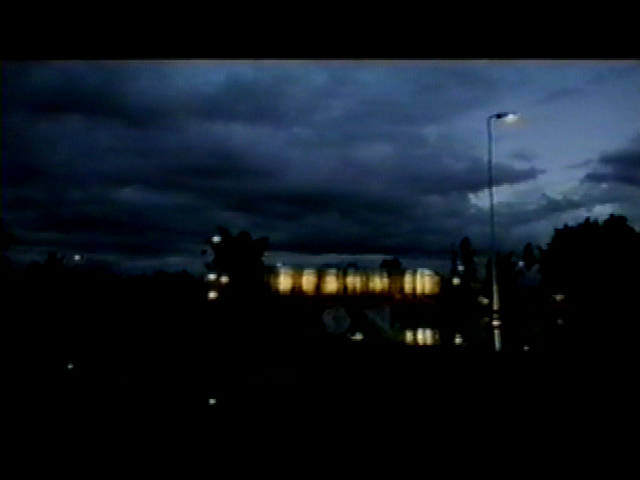
Philippe Parreno's The Boy From Mars is "science fiction." Better yet, it's "architecture fiction." There is no Martian boy in this film. It does feature a rather weird building, however. In some solemn, rural, Southeast Asian retreat, the dark, marshy earth is infiltrated by unearthly lights. A constellation of UFOs wanders the zenith, a pack of gentle flame-beings from beyond. The wind-tattered storm clouds are some how frozen stiff against the sky.

We see no human beings, but some intelligent entity has an agenda in this place. A strange orange glow infests an alien structure. This ragged, rambling creation looks comfortably at home in an Asian rice paddy, but, after a closer look, it makes no sense. Could it be a broken greenhouse? A geodesic aircraft hangar? It is multi-legged like a caterpillar, it has flapping, tattered plastic walls, and rigid stalks for rafters. Plus, it radiates a thick, warm light. This place is clearly unfit for any merely human habitation. Inside this place, some entity has harnessed a patient water buffalo to an electrical generator. It's a bizarrely ingenious device of weights, light bulbs and pulleys straight off the set of Spielberg's E.T. the Extraterrestrial. The gentle soundtrack cannot distinguish between the sighing of the wind and the calm grinding of this alien machinery. Exotic plants dance on the windy slopes of the hills. A healing rain comes, eventually. The foggy sky resumes its motion, the sun peeps in, glares at the invaded Earth, and quietly retreats. Everything seems in good order. The placid water buffalo our hero, if this piece has one calmly endures a close encounter with a swaying alien light beam.

Friends from far away show up: a set of blurry, two-legged tourists, invading the spidery building. They move slowly and meditatively behind their steamy walls of glowing film. Although they're not human, one gets the impression that they've earned the right to visit. Maybe they'll settle down.

The Boy From Mars is about the joys of being alien. Philippe Parreno (playing the intriguing role of "The Boy from Paris") was able to vent his customary ingenuity on the Thai artist's retreat of his friend and collaborator, Rirkrit Tiravanija. This locale was anonymous, off the electrical grid, basically a fertile patch of mud in the middle of nowhere. Anything and nothing was possible there. So, Parreno and architect Francois Roche invaded this timeless Asian farm and boldly created an architectural freak. It's the hybrid of a science fiction film-set, a green design showpiece, an assembly hall, and an international artists' squat. Plus, it's literally powered by a water buffalo. It must be well nigh perfect if Martians happen to drop by.

Furthermore, this construction, whose artsy French origin couldn't be any more alien to Thai rurality, suits its locale remarkably well. Perched in a Chiang Mai rice field, it looks as imperturbable as a pig in mud. This work is especially apt for a period in which machines from Earth are invading Mars. As I write this, Spirit and Opportunity, those twin American hot-rods, are vigorously filming the unresisting Martian landscape. As video performances go, that scientific stream of images from that alien planet: those dull, eroded Martian hills, smears of ancient salt, spinning mechanical drills, ferocious close-ups of Martian pebbles and sand...that is hard for artists to match, but The Boy From Mars makes an attempt

In our epoch, Mars finally became banal. Now we humans are importing all its strangeness. Thanks to this Parreno piece, I can appreciate that simple truth.


Download this at KaraGarga.

at 1:02 AM  

Jeremy Blake - Century 21 (2004)

Download this at KaraGarga.

Jeremy Blake studied traditional painting in art school. "If you had asked me if I was interested in computers as a tool to make art, I would have said no," he says. But when Blake graduated from Cal Arts in 1995, he needed a job - and found a gig in New York as a digital photo retoucher. "I worked for a Corsican guy who berated me in French because I was so bad," Blake recalls. "After a few months he said, 'Jeremy, I'm very sorry because you are cool guy, but you have no future in computer!'" The job was a disaster, but the experience of manipulating images pixel by pixel lit a fuse. "The computer is the visual equivalent of an electric guitar," Blake says. "I was trained on an acoustic."

Ten years later, Blake has combined painting and computers to produce a techno take on traditional portraiture. His latest subject is Sarah Winchester, the eccentric heir to a firearm fortune. After her husband and infant daughter died in the 1880s, she concluded that the family was cursed, haunted by the spirits of those killed with Winchester rifles. On the advice of a medium, she built an enormous mansion in San Jose, California, to appease the ghosts. "I had read about it as a kid," Blake says. "I knew it was a house built around superstition - a fear of dead gunfighters - and it seemed to reflect contemporary events." Blake's 51-minute portrait of Winchester is contained on three DVDs, which will screen together in the US for the first time at the San Francisco Museum of Modern Art beginning February 19.

The first film, Winchester (2002), opens with the family mansion fading in and out of focus as the shadow of a gunman drifts across the screen. Odd elements are juxtaposed - cowboys from old ads morph into tracings of the house's art nouveau wallpaper. The second DVD, 1906 (2003), returns to the mansion after the great '06 earthquake. A maze of cracked plaster, winding corridors, and stairways to nowhere becomes a metaphor for Winchester's deteriorating mental state. Blake widens the view in the final chapter, Century 21 (2004), to explore the sickness - and the sexiness - of American violence. Each film runs in a continuous a loop - no titles, no credits. "Neurosis," Blake says, "is a broken record in your head." The cumulative effect is somewhere between a great expressionist painting and a bad acid trip.

Each frame of the trilogy is constructed in layers, like a conventional painting. Blake combines video, drawings, gouache, still photography, 8- and 16-mm film, and CG graphics. "For me," he says, "the computer is a way to get all your favorite mediums around the dinner table - and get them arguing." The technique places Blake among the new masters working with computers today who have moved beyond whizbang effects to celebrate pure aesthetics. "There are many people working with an individual medium," says Christiane Paul, a curator at New York's Whitney Museum of American Art, where two of Blake's DVDs are in the permanent collection. "What distinguishes Jeremy is that he works in a variety of mediums in a very painterly way."

Blake has taken his craft beyond the gallery walls. He designed the cover for Beck's Sea Change album and produced abstract visuals for Paul Thomas Anderson's film Punch-Drunk Love. Trading art-world pretensions for the practicalities of the music and film studio were welcome changes: "I like artists who don't feel superior to the culture they critique."

---


The Winchester trilogy was inspired by my interest in the Winchester Mystery House in San Jose, California. The Mansion is an architectural wonder that Sarah Winchester, widow of the heir to the Winchester rifle fortune, constructed over the course of 38 years, beginning in the late 1800's. After suffering the premature death of her child and then her husband, Winchester, informed by her deep belief in Spiritualism, concluded that the angry spirits of those struck down by her family's guns had cursed her. An advisor agreed and suggested that she build an enormously large house--an endeavor that would both accommodate good spirits and ward off evil ones with the sounds of never ending construction. The result is an eccentric, sprawling 160-room mansion, well outfitted for the undead with staircases going nowhere, doorways leading out into open air several stories above ground, and miles of darkened hallways for the spirits to roam.

The Winchester films combine 8mm film footage, static 16mm shots of old photographs, hundreds of ink drawings, and intricate frame-by-frame digital retouching. They are meant to provide an abstract and emotional tour--not so much of the architecture, but of some of the more fearful chambers of Sarah Winchester’s mind. The abstract imagery represents supernatural activity, heightened by paranoiac glimpses of shadowy gunfighters, painterly gunshot wounds blossoming into Rorschach patterns, and a spectrum of images from Winchester rifle advertisements. The entire series is informed by the idea that the Victorian aesthetic (embodied by the Mansion's architecture) and the psychedelic sensibility (referenced through hallucinatory manipulation of the film) are sympathetic opposites.

My interest in the Mansion is rooted in an understanding that the site is more than just a monument to one person’s eccentric preoccupation—it is the tangible outcome from a collision of social and historical narratives. The series ties together several mythic strands fundamental to an American national identity in an attempt to justify Winchester’s architectural free-for-all. The figure of the gunfighter facilitates spiritual regeneration through violence, and lawmen and outlaws are thus treated with reverent trepidation—as are the ghosts of their victims.

Beneath the dreamlike flow of images, the structure of the films is very deliberate:

Winchester combines static 16mm historical photographs of the house, drawings, and laborious digital manipulation to convey a psychological portrait of the house. Accompanied by a moody soundtrack, the piece opens with a black-and-white shot of the architectural facade. Superimposed over the house, the silhouette of a gunfighter fills the frame, alluding to the Winchester legacy. As the film unfolds, both mansion and rifleman are eclipsed by veils of saturated color and kinetic abstractions. Painterly shapes resembling gunshot wounds morph into Rorschach–like inkblots and back again into rifle–bearing specters.

1906 takes much the same approach with synthesized film footage as well as images from my paintings and drawings, but it shifts its focus to the interior of the mansion and the parts of the house that suffered most in the earthquake of 1906. Sarah Winchester chose not to repair certain damaged sections, preferring to build around them, as she imagined that the house's resident spirits disapproved of these accommodations. To shoot live footage for this DVD, I used Kodak 8mm for its simultaneous painterly and touristy quality. The film begins and ends at the highest point of the house, creating a continuous sense of descent, and uses the sounds of construction mixed with period music.

Century 21 moves from the roof of the Winchester house to zoom in on a complex of three domed, space-age movie theaters situated across the street: Century 21, Century 22 and Century 23, alluding to the fact that it is film, TV and the media that perpetuate the icon of the gunfighter. The work consists of three short sections intended to represent what is “playing” in each of the theaters. These include richly layered montages of the Old West and pop-culture imagery, as well as art and film celebrities who appear as phantom stand-ins to embody the specters of the Cowboy and of Sarah Winchester herself.

The Winchester series distills and abstracts American myths of violence and spiritual reconciliation.


Download this at KaraGarga.

at 1:01 AM  

John Baldessari - John Baldessari: Films Transferred to Video 1972-1977 (1972)

Download this at KaraGarga.

Baldessari’s cinema works on DVD.

Baldessari’s cinema works primarily in the Space of the spectator and opens up the filmmaking field to other language forms, to other story telling procedures. The film is no longer a narrative progression but rather a succession of near-still, suspended, photographic moments. Baldessari’s film aesthetic is built around his conceptual photographic work, an obsession with the non-link, with fragmentation and gaps. Images are both autonomous and integrated forms, time-image units referring to an ever-evolving film. It is up to the spectator to reconstruct and project a structure, to make up sequences from images.

"Title" is without doubt one his most radical Projects, a juxtaposition of extremely minimal images following each other without hierarchy nor direction. In this work Baldessari isolates and breaks up a classic film into its component parts. First the objects, the characters, the landscapes, then the frames associating two shapes, and finally the start of an action, of a dialogue.
In this way he shows the precise making and manipulation of meaning, the tricks of cinematic space-time.

In "Six Colorful Inside Jobs" he draws a parallel between a double process of life and creation. The video shows a room being painted in six different colors, each color of the spectrum corresponding to a day of the week. This work, which started as a performance/installation, integrates the artist as a comic figure faced with contemporary history—that of American painting—and shifts his function toward that of a house painter. Through this form of irony, Baldessari shows to what extent instruments and materials help him define the subtle limits between art and work, art and life.

"4 Short Films" is the product of the same ironic twist, a free and absurd association between time, matter, and objects. (Stéphanie Moisdon).


Download this at KaraGarga.

at 12:59 AM  

Various - The PureData~Convention 2004 (2005)

A potpourri of audio, video, audio-visual and documentary works of artists that participated at the 1st international pd~convention in Graz, autumn04.

Collection of works and documents of PureData artists.

Pure Data (or Pd) is a graphical programming language developed by Miller Puckette in the 1990s for the creation of interactive computer music and multimedia works. Though Puckette is the primary author of the software, Pd is an open source project and has a large developer base working on new extensions to the program.


Download this at KaraGarga.

at 11:32 AM  

Åke Hodell & Per Wiklund - Lågsniff (1965)

Download this at KaraGarga.
Directed by: Åke Hodell and Per Wiklund
Photo: Per Wiklund
Performers: Åke Hodell, Torsten Ekbom, Bengt Emil Johnson,
Leif Nylén, Sissi Nilsson and Elisabeth Nylén.
Running time: 20 minutes.

This is one of the most essential DVD-releases of 2002, by the controversial Swedish text-sound poet Åke Hodell (1919-2000). "Lågsniff" is only screened once on Swedish television in 1965, and then creating such a stir that the film immediately was put into the dark vaults of SVT, where it has been hidden since.
Now the amazing visual recording of the event has been made available on DVD, 37 years after.
This experimental stageplay is a masterpiece in the use of live voices, (by fellow leading avantgardists of the time, Bengt-Emil Johnson, Leif Nylén a.o.) black and white cut ups and an innovative use of the camera.

Åke Hodell (April 30, 1919 - July 29, 2000, Stockholm, Sweden) was a Swedish fighter pilot, poet, author, text-sound composer, and artist. Son of author Björn Hodell and brother of actor Ulla Hodell.

Hodell was trained as a fighter pilot, but after a crash during practice July 17, 1941, he had to spend the next few years in hospital. This became a turning point and he became a dedicated antimilitarist. Lying in hospital he got to know author Gunnar Ekelöf and Hodell made his debut with Flyende Pilot in 1953. That same spring Hodell and Ekelöf travels to Rome. In his books, Hodell experiments with what he calls elektronismer, while he on stage and in radio in the early 60's works with text-sound composition. During this period he is also active at Pistolteatern in Stockholm. He also creates publisher Kerberos.

Download this at KaraGarga.

at 11:29 AM  

Mores McWreath - The Bud, the Seed, the Egg (2008)

Download this at KaraGarga.

"In this video I use the structure of YouTube and vaudeville to directly address ways of challenging the hegemony of capitalism through Roland Barthes concept of the Neutral. Barthes defines the Neutral as “that which baffles the paradigm,” it is an expression of “the right to silence.” The performer/character, played by myself, goes through a variety of performances that touch on a broad range of subjects from the state of artists in a capitalistic society to sex and power to the pronunciation of the word Iraq that immediately degenerates to gibberish. The video takes place exclusively in a neutral space that oscillates between an empty office, classroom, gallery, or retail space. The artifice of that neutrality becomes explicitly apparent as my performances become increasingly antic. Inspired in part by Beckett’s Waiting for Godot and Happy Days, all of these vignettes come together to form a sometimes humorous, sometimes tragic expression of ambivalence and frustration. It is a portrait of an individual facing a world of decisions and finding only burden, not freedom, in capitalistic notions of abundance. The “neutral” is a place outside of the decision making process, a place of pure potential that I am trying to reach in this video." (Mores McWreath)


Installation shot:

Download this at KaraGarga.

at 11:12 PM  

Andy Warhol - Outer and Inner Space (1965)

Download this at KaraGarga.

One of Andy Warhol's most important works of art, one of the very first works of video art, an absolute masterpiece. Sound awful in this version. Hoberman gets a few facts wrong below, but it's a great short review. -mb

FILM; A Pioneering Dialogue Between Actress and Image
By J. HOBERMAN

ANDY WARHOL has so become his own trademark -- and is so much a one-name synonym for the culture of celebrity -- that it can be a shock to realize just how brilliantly original he was as a visual artist. A case in point: The double-screen video-based film installation ''Outer and Inner Space'' at the Whitney Museum (through Nov. 30), which places his glamorous, doomed superstar Edie Sedgwick in a dialogue with her own video-taped image.

First shown in 1966 and largely forgotten for some 30 years thereafter, ''Outer and Inner Space'' is a historical anomaly -- a masterpiece of video art made before the term even existed. The piece meditates on the distinction between film and tape while introducing the issues of real-time recording and simultaneous feedback that would inform much video art from the 1970's on. For the Whitney adjunct curator, Callie Angell, '' 'Outer and Inner Space'' ''creates this classic background for video art that it didn't know it had.''

Mid-summer 1965, a few months before the father of video art Nam June Paik got his first Sony PortaPak, a prototype Norelco slant-track video recorder was delivered to the Warhol Factory. (Its arrival, Ms. Angell points out, is an event in the hectic first chapter of Warhol's ''documentary'' novel ''A.'') The Norelco video recorder was expensive, unwieldy and short-lived. There are no extant machines. Warhol, then producing a 16-millimeter feature every other week, played with the video equipment for a month. A documentary of the Factory scene produced by Bruce Torbet that summer shows a surprisingly hands-on artist -- Warhol himself wielding the white tubular-shaped Norelco camera as he supervises the lighting of the 22-year-old Sedgwick, perched demurely on a stool.

These tapes, as played back on a large monitor, were the basis for a two-reel, 66-minute movie with Sedgwick positioned before, responding to and illuminated by her video image. (Thanks to this lighting, unconventional then, the film seems less black and white than gorgeously black and silver.) Shot in profile and close-up, the video Sedgwick is uncharacteristically earnest, staring off camera with an almost mystical concentration as she talks on and on about . . . something. A typically laconic Factory description explains that her ''duo dialogue'' concerns ''space, mysticism and herself.'' Although the tape is manipulated to produce intermittant video distortions and bar rolls, the most subtle effect has the video Edie slightly larger than life. Space is flattened, perspective destroyed. In a further temporal complication, Warhol arranged for the two 16-millmeter reels to be projected simultaneously side by side.

Suggesting both the silkscreened multiples of Marilyn Monroe or Jacqueline Kennedy, as well as Warhol's vast series of 16-millimeter screen tests, ''Outer and Inner Space'' is one of his great portraits. Her lips glossed and eyes shining, a pair of enormous dangling earrings casting a grid of shadows across her graceful neck, the film Sedgwick was never more appealing than here. Poised and elegant, she acts as though it's tea time on Mars. Sedgwick never stops talking, unless it's to draw on her cigarette or pull a face, presumably in response to something she hears her video self say. The four layers of Sedgwick discourse become a murmuring burble in which only isolated phrases (''We had better times than anybody else,'' ''I don't believe it'') float to the surface of audibility.

''Outer and Inner Space'' had its world premiere at the Filmmaker's Cinematheque in Manhattan. (An advertisment in the Jan. 27, 1966 issue of The Village Voice drolly promises new work by Andy Warhol and the teen-age underground filmmaker Barbara Rubin as ''double screen experiments by double screen experimentalists.'') Later, it was incorporated into Warhol's growing multi-media show, the ''Exploding Plastic Inevitable,'' which featured not only the rock band the Velvet Underground but also the continuous projection of Warhol movies on the walls and ceiling of the St. Marks Place discotheque known as the Dom.

Although Warhol would only once again work in video, Ms. Angell believes that ''Outer and Inner Space'' had a decisive influence on his development. She points out that nearly every film he made afterward was shown in some sort of double screen: ''After a certain point, Warhol thought he could combine any of his films in any way he wanted.'' It was during the spring of 1966 that the artist began shooting ''The Chelsea Girls,'' the double-screen movie that would be his greatest critical (and commercial) success. Still, there are few Warhol movies as concerned as ''Outer and Inner Space'' with their own process.

What ''Outer and Inner Space'' shares with much video art is its sense of immediacy. As in many of the early Warhol films, an onscreen performer can be seen interracting with people offscreen. At one point, Sedgwick visibly responds to a direction, presumably from Warhol, to sneeze in tandem with her video image. The most powerful ''off-screen'' presence is, however, the taped image, which Sedgwick can hear but not see.

Becoming in a sense her own audience, the ''live'' Sedgwick often seems startled, distracted, even sometimes distressed by the effect of having her own voice whispering in her ear. (''It makes me so nervous to listen to it,'' she exclaims at one point.) As its title suggests, ''Outer and Inner Space'' visualizes a fragmented attention, a schizoid disjunction between public and private selves. Never less than animated, Sedgwick appears to approach hysteria -- perhaps annotating her video monologue, perhaps freaked out by it.

The four faces of Edie, ''Outer and Inner Space'' is ultimately the poignant spectacle of watching a beautiful wraith reacting to her own past. (Scarcely six years later, Sedgwick was dead of a drug overdose.) In a way, the piece makes literal the celebrity's dilemma: the superstar is trapped between her own disembodied image and the implacable, voracious eye of Warhol's camera.

J. Hoberman is the senior film critic for The Village Voice.


Download this at KaraGarga.

at 11:06 PM  

Danny Plotnick - Warts & All: The Films of Danny Plotnick (2008)

Download this at KaraGarga.


Warts & All: The Films of Danny Plotnick

Danny Plotnick roared into the underground film world in the 1980s. Fueled by his love of punk and alternative culture and infected with d.i.y. spirit, he started making films that captured a
similarly snarly attitude. His films were pegged as bawdy, bad-mouthed and beautiful, straddling the line between high-brow and low-brow art. It’s no surprise that his work has screened from the MOMA in NYC to mortuaries in Baltimore to the Independent Film Channel. With little opportunity to screen this type of work in the 80s, Plotnick took to the road, projector and films in trunk, screening in bars, warehouses and cafes. Plotnick trail blazed a path for the underground film world that exploded in the early 90s, a scene that would ultimately champion his work.

Working in the pre-digital age, Plotnick was a fierce advocate for super 8 filmmaking. He took this 1960s home movie medium with limited capabilities and made work that stands tall regardless of format. The special features on this dvd are an important document for students of film, providing a rare glimpse into the world of sound super 8 filmmaking.

The films on this disc include Swingers’ Serenade, a titillating tale of suburban sexual malaise; I, Socky, a rogue sock monkey hits the town on a big day out; Steel Belted Romeos, a turbo-charged tale of California road rage; Skate Witches, a glimpse into the world of a 1980s female skateboard gang; Flip About Flip, a tribute to comic genius Flip Wilson.

Download this at KaraGarga.

at 11:03 PM  

Anri Sala - Now I See (2004)

Download this at KaraGarga.

Upon entering the installation of Anri Sala’s Now I see (2004), his first 35-mm film, the viewer is enveloped in total darkness. The effect is, at first, purposefully disorienting; then a flicker of light flashes upon a 10 x 12 foot screen. A second or two later, the face of a young man emerges from the pitch-black along with the pulse of an electric guitar.

What follows seems to adhere to fairly standard conventions of rock video, with its guitar antics and male posturing, until a dog-shaped balloon falls on to the stage and disrupts the scene.

Despite the film’s opening pretense, Sala is anything but a conventional filmmaker. Trained as a painter in his native Albania before studying film in France, Sala, now based in Berlin, merges an interest in color, particularly black and white, with structuralist explorations of language and sound. - Susan Snodgrass (chicago)


Download this at KaraGarga.

at 5:10 PM  

Joan Jonas - Glass puzzle (1973)

Download this at KaraGarga.

This complex and enigmatic work, which is performed by Jonas and Lois Lane, explores female gestures, poses, the body and narcissism. Mirroring each other with synchronized movements as they perform as alter-egos, Jonas and Lane reference archetypal female gestures and poses from popular and traditional cultures. Throughout the performance, space is dislocated and altered as a formal device — segmented by a swinging bar, superimposed in layers, transformed by subtle changes in light and shadow, or flattened by the video screen. With its evocative personal theater and idiosyncratic vocabulary of gestures, ritual and symbolism, Glass Puzzle is a quintessential Jonas work.

Camera: Babette Mangolte. Music: The Liquidators. With: Lois Lane, Joan Jonas.


Download this at KaraGarga.

at 12:06 PM  

Lynda Benglis - Mumble (1972)

Download this at KaraGarga.

Part of an ongoing video correspondence with sculptor Robert Morris, Mumble brings together repeated scenes and gestures, featuring Morris and Jim Benglis (the artist's brother), and a narrative of irrelevant, confusing, and often purposefully untrue, statements. Although the viewer is inclined to accept Benglis's narrative as true, such trust is called into question by her statements about actions taking place off camera—actions that cannot be verified. As Benglis's narration degenerates into a meaningless, repetitive pulse, Mumble disrupts the convenient fiction that the image presented on screen is complete unto itself.


Download this at KaraGarga.

at 12:01 PM  

Claes Oldenberg - Fotodeath (1961)

Download this at KaraGarga.
16mm film of Claes Olderberg's 1961 Happening "Fotodeath".


Download this at KaraGarga.

at 4:52 PM  

Studio Azzurro - Synchronized Videos (1989 - 2000)

Download this at KaraGarga.

Studio Azzurro is an artistic research studio, that bases its expression on the languages afforded by recent technology. It was first set up in 1982 by Fabio Cirifino (photography), Paolo Rosa (visual arts and film) and Leonardo Sangiorgi (graphics and animation). In 1995 Stefano Roveda, an expert in interactive systems, joined the group.
For over twenty years, Studio Azzurro has been investigating the poetic and expressive potential of these systems that have had such an impact on relations in this age. Through video-environments, sensitive and interactive environments, theatrical performances and films, it has blazed a trail that is now acknowledged worldwide, by countless major artistic and theatrical institutions and events. In addition to experimental work, the groups activities are also tied in with more formative experiences such as the designing of museums and theme exhibitions whose cultural value has been recognised at all levels. In both cases, Studio Azzurro has taken care to create communicative environments that require an active and significant participation on behalf of the spectator who is part of the narrative structure, inspired by a use of multitextual approach and a continous shift between virtual and real elements.


The Synchronized videos are made up of two or more videos transmitted simultaneously. The videos are set up in order to restore an organic nature to what is viewed. It is like holding a continuous dialogue at times moving along together, sometimes involving an exchange, and at other times there is a meeting to create a single scene.

Il combattimento di Ettore e Achille (1989) aka The battle between Hector and Achilles (1989)

Two screens, two simultaneous points of view, two eyes that focus on this episode taken from Homer's epic. At times the images match as happens with human vision, and at other times they are separate and interchangeable, as happens with thought. The screens, placed side by side, recreate scenes and landscapes and the images of the actors move from one space to the next in a constant swapping of identities and roles. The emotions are heightened by the drawn out alienated time scale of the narration and the spread out slow motion of the action. The memory of the fight seeps into the landscapes' very texture, winds its way into the dancer's bodies, and a true synthesis is reached, devoid of all mythical allusion or epic reconstruction.


Aleksander Nevskij Video (1989)


Thanks to editing, excerpts from Ejzenstejn’s film and footage of a concert performance of Prokofiev’s cantata come together in the video with the aim of interpenetrating through the use of video processing. The performers in the film and concert appear side by side in the same picture. As was the idea of both Ejzenstejn and Prokofiev, who worked in close contact for the film and composition’s production, the video aims to retrace this co-operation, reinventing a series of associations between the musical content and a number of images from the film.
A particular succession of structural cross-references represent an effort to fuse genres and languages – musical, cinematographic, and the strictly video-electronic one.


Trittico Marghera (2000) aka Marghera triptych (2000)


Porto Marghera, the search for signs in a poisoned, hard, landscape. One finds a few life forms - an embryo of fertility mixed in with the remains of a people that has lived and suffered there, and has found its own identity in this suffering. Small indications of life that are confronted by immense empty or devastated spaces. Vast cathedrals, rusty machinery, reinforced concrete bunkers threatened by minute cracks - small havens for new vegetation. Hell has burnt itself out and left space for the first signs of life. The gaze examines, searches and focuses on the microscopic presences in the pools, beneath the layers of dust, amidst the lightness of feathers. What we see materialises on three screens that synchronise the impressions, emotions, and fears.


Trittico di sale (2000) aka Salt's triptych (2000)

Trittico di sale was specially produced for the “2000 anni luce” exhibition at the Parmigiani Museum in Reggio Emilia. We set up this small piece of work entitled Trittico di sale comprising three opaque glass screens supported by a salt base. The subject, light, was portrayed using the whiteness of a Trapani salt deposit as the starting point. It is so dazzling that it tends to burn the space the image occupies, just as the evocations of the wind in Salvatore Sciarrino's music (La perfezione di uno spirito sottile), wich runs parallel to the image tends to silence. Trittico di sale is part of a series we entitled Miniatures, small works with a clear narrative development that we installed at different historic locations such as Castel Sant'Angelo in Rome.

Download this at KaraGarga.

at 9:34 PM  

Aleister Crowley - The Other Loch Ness Monster (2000)

A little different view on Crowley then from 'the wickedest man in the world'. This time it focuses in on Boleskine house, the things that he did there and what became of it afterwards.

Download this at KaraGarga.

at 8:30 PM  

Neil Rawles - Masters of Darkness: Aleister Crowley - The Wickedest Man in the World (2002)


Download this at KaraGarga.

at 8:28 PM  

Robert Garofalo - In Search of the Great Beast 666 - Aleister Crowley (2007)

Download this at KaraGarga.

Aleister Crowley, self proclaimed "The Great Beast" and known by the press as "The Wickedest Man in the World", was perhaps the most controversial and notorious individuals in British History. This dramatically reconstructed film unearths the barely believable and shocking facts surrounding a man who was voted in a BBC poll to be one of the most influential Britons of all time. Was he related to US President George Bush? How was he connected to the founder of Scientology, NASA, The Beatles, Led Zeppelin, Jack the Ripper, Winston Churchill, Ian Fleming and how did this Occultist, Spy, Poet, Writer and accomplished Mountaineer come to know and influence so many other remarkable people?

In Search Of The Great Beast 666 - Aleister Crowley.

Featuring the Voice of Joss Ackland and Music Score by Rick Wakeman.


Download this at KaraGarga.

at 8:25 PM  

Mauricio Kagel - Blue's Blue (1981)


Download this at KaraGarga.

at 8:23 PM  

Various - U.S. Express - Early 21st Century Video Art (2005)

Download this at KaraGarga.

1. Sign Movie
Karolina Sobecka 1:10 2001

Sobecka's videos are lyrical metaphors, rich enough to hold many interpretations. To us
they are about seeking connection with the physical world through our senses: sight,
touch, movement. Sobecka transforms her camcorder footage with staccato editing,
pixilated video animation, and other computer techniques. In this 21st century road movie,
a black and white traveler speeds through a lush color California landscape in the blink of
an eye, looking for signs.
Karolina Sobecka was born in Warsaw, Poland and is a graduate of the School of the Art
Institute of Chicago. Her works have been screened at the Women in the Director's Chair
2000 Tour and 19th Annual International Film and Video Festival; Dialogues @ Matthew
Gallery (Edinburgh, 1999); Animac International Festival in Lleida, Spain; Cinanima Film
Festival in Portugal and many others.

2. Welcome to My Home Page
Paper Rad 3:00 2003

High spirited, frenetic music drives an over the top, eyeball-saturating excerpt from
PjVidz#1: Color Vision. Paper Rad, creator of this digital divertissement, is an artist
collective that synthesizes popular imagery from TV, video games, and advertising,
reprogramming the references with an exuberant, imaginative aesthetic. Members
Benjamin Jones, Jessica Ciocci, and Jacob Ciocci have performed and exhibited at Foxy
Productions, Brooklyn, NY; the Museum of Contemporary Art, Chicago; the NY
Underground Film Festival; the Big Orbit Sound Lab, Buffalo, NY; Space 1026, Philadelphia,
PA and others.

3. Modern Daydream: Islands in the Sky
Mitchell Rose 4:32 2001

Out in the desolate countryside, dancers atop cherry-pickers weave fifty feet in the air,
reaching for the clouds and for each other in extraordinary gestures of yearning that are
amplified by the giant machines and sweeping camera movements. This strong and
beautiful dance video was directed by Mitchell Rose, a choreographer, performance artist,
and now mediamaker, based on the West Coast. He’s made seventeen short films that
have garnered many festival awards and been screened in theatres, television, museums,airlines, the Internet, even on the CBS JumboVision in Times Square.

4. Imprint
Karolina Sobecka 0:48 2003

The artist considers this video to be about human touch but we think it's about reach. Her
editing style collapses time, and merges multiple efforts to connect with the world into one
universal gesture.

5. Docking at X
Anita Thacher 7:06 2001

The artist dreams a silent journey along the coast, through fields and trees and fog.
Mysterious images obscure the view at times; an “X’ appears and disappears; a trapeze
artist swings gracefully through the air and slides down a rope, perhaps to return to her
dreamer’s bed. Docking at X while always in motion means being where you are. Anita
Thacher is a New York-based artist known for her indoor and outdoor multimedia
installations, films, videos, and photographs. Her works have been seen at the New York
Film Festival, Whitney Museum (NY), Berlin and Melbourne Film Festivals, Jeu de Paume,
Belgium Cultural Center and many others.

6. Current
Brian Doyle 6:00 2001

In New York City’s Financial Center, a blizzard of paper and tickertape swirls wildly in the
turbulent air that blows through the narrow streets; satellite dishes sprout from every
building. Paper shows the wind; the electromagnetic currents are invisible. Glimpses of
the World Trade Center twin towers are eerie but merely a background to a serendipitous
free-form paper dance. Brian Doyle is a Brooklyn, NY installation, video and photo artist
who has had many screenings including Lighthouse Museum (Glasgow, UK), Rotterdam
Film Festival, L’Alternativa (Barcelona), Instituto Brasileiro de Audiovisual, Pierogi 2000,
Slamdance 2003, Arte’s Mic Mac 8 and the New York and the Chicago Underground Film
Festivals.

7. One Mile Path
Karolina Sobecka 2:08 2003

In this third video by Sobecka, a barefoot woman walks across many landscapes, taking
careful deliberate steps, as if walking for the first time. Then she lifts her gaze toward the
skies, connecting multiple images of heaven and earth.

8. Weekend in Moscow (unofficial art)
Skip Blumberg 3:00 1990/2002

This short excerpt is the antic opening of a 35-minute non-fiction video about American art
aficionados touring Moscow during the last days of the Soviet Union. The humorous, ironic
first-person travel diary focuses on visits to the studios of an underground community of
talented, courageous and often wacky “unofficial,” conceptual artists. Skip Blumberg produces cultural documentaries and performance videos that have been seen on TV
networks, in festivals and art galleries around the world.

9. There There Square (condensed)
Jacqueline Goss 5:40 2002

Where is there? In this silent video (condensed from the full 14-minute video), Goss
eloquently uses terse text and fluid visual coverage of the U.S. map to present fascinating
facts and personal ruminations. She tells us that when the explorers arrived on our
shores, natives drew maps with circles that filled the square paper. Today the national
map is an indelible image for its citizens, yet they still draw highly idiosyncratic versions of
it. Jacqueline Goss’s videotapes and multimedia projects have been screened
internationally including the New York Video Festival, Rotterdam International Film
Festival, the Hong Kong Film Archive and Flaherty Film Seminar. She teaches in the Film
and Electronic Arts Department at Bard College, Annandale, NY.

10. Language Lessons
Pamela Z, Jeanne C. Finley & John Muse 9:00 2002

Z, Finley and Muse have woven an intricate pattern of narrative fragments about dreamers,
outsiders, and believers. Otherworldly images of ordinary objects - immigration forms,
butterflies just out of reach, toy airplanes and watery baptisms - obliquely illustrate their
words. Viewers must discover the connections and untangle meanings for themselves.
Pamela Z is a San Francisco-based composer/performer and audio artist and has toured
extensively throughout the U.S., Europe, and Japan with her audio works included in
exhibitions at the Whitney Museum (NY) and the Erzbischöfliches Diözesanmuseum
(Cologne). Jeanne C. Finley and John Muse have worked collaboratively on numerous
experimental documentaries and multi-channel video installations since 1988.

11. One Mile Per Minute
Bobby Abate 10:00 2002

Bobby Abate takes us on a sentimental drive through a fictional post-9/11 America where
nothing has changed; it’s a landscape of media, products, logos, and tract homes. Abate’s
work deals with ritual, commercialism, self-reflexivity and contradiction and appeared in
the 2000 New York Film Festival plus many more off-beat venues. His trilogy of Internet
video shorts, Real Videos, was named one of the top avant-garde works of 2001 in the
Village Voice.

12. The Light
Brian Doyle 10:18 2003

This video, by the maker of Current, is an exquisitely photographed, crisply edited,
amazingly detailed study of artificial lights. The fluctuations between darkness and
brightness enhance our awareness of the light emanating from a video screen. At first
there is incidental coverage, then extensive coverage of the World Trade Center memorial
twin towers of light.

13. Cookie Girl in the Hot Zone
Skip Blumberg 4:30 2001

Two days after the World Trade Center twin towers collapsed 12-year-old Jemma Brown,
who lives just a few blocks from the site, baked and served cookies to rescue workers at
the end of their shifts, walking away from the clean-up of the still burning rubble. “Thanks
to all who helped in the recovery efforts.”

14. Robots/Cyborgs/Immortality
(from Act 3 Dolly of the 64-minute video opera Three Tales)
Beryl Korot (video) & Steve Reich (music) 11:35 2002

In this segment the robot Kismet and creator Cynthia Breazeal are featured in a tour-de-
force blending of audio/video fragments of ideas about artificial intelligence. The opera
stars engineers, scientists and philosophers (Ray Kurzweil, Sherry Turkle, Marvin Minsky,
Bill Joy, Henri Atlan, Rodney Brooks, Richard Dawkins, Ruth Deech, and Adin Steinsaltz). It
includes a luscious, rousing Steve Reich score and Korot’s expert intricately woven multi-
screen, multi-media, digital visualizations.
Beryl Korot is a seminal video artist, co-founder and co-editor of Radical Software, the
journal for the 1970's video movement. Her multi channel video installations have been
exhibited in galleries and museums around the world including the Whitney Museum (NY),
the Reina Sofia and the Dusseldorf Kunsthalle. Three Tales, her second video opera in
collaboration with composer Steve Reich, was performed with live musicians and singers
in Paris, London, Berlin, Torino, Amsterdam, Strasbourg, Lisbon, Vienna, Hong Kong,
Perth, New York, Chicago and Charleston, SC in 2002-2003.


Download this at KaraGarga.

at 5:08 PM  

Janet Cardiff & George Bures Miller - The Killing Machine and Other Stories (1995-2007)

Download this at KaraGarga.

Cardiff and Bures Miller represented Canada at the 49th Venice Biennale with Paradise Institute (2001), a 16-seat movie theatre where viewers watched a film, becoming entangled as witnesses to a possible crime played out in the real world audience and on the screen. The artists won La Biennale di Venezia Special Award at Venice, presented to Canadian artists for the first time and the Benesse Prize, recognizing artists who break new artistic ground with an experimental and pioneering spirit. Cardiff and Bures Miller have recently had exhibitions at the Miami Art Museum (2007) Vancouver Art Gallery (2005), Luhring Augustine, New York (2004), Contemporary Arts Center, Cincinnati (2003), Art Gallery of Ontario (2002), National Gallery of Canada (2002) and Oakville Galleries, Oakville, Ontario (2000).

More info at: link.


Download this at KaraGarga.

at 10:05 AM  

Vito Acconci - The Red Tapes (1977)

Download this at KaraGarga.

The Red Tapes is Acconci's masterwork, a three-part epic that is one of the major works in video. Designed originally for video projection, the work is structured to merge video space — the close-up — with filmic space — the landscape. Acconci maps a topography of the self within a cultural and social context, locating personal identity through history, cultural artifacts, language and representation. Stating that the work moves "from Vito Acconci to a larger Americanism, between a psychological personal space and a cultural personal space," he constructs a dense, poetic text in this search for self and America.
Opening with the image of Acconci, blindfolded, the tapes evolve as a complex amalgam of narrative strategies, photographic images, music and spoken language. The formal system is the alteration of blank screen and image; grey screen is paired with voice, which leads to image, which leads back to grey screen with voice, etc. In Tape 1: Common Knowledge, the focus is on representation and self (as Acconci is seen in close-up), landscape is a photographic image, and the narrative is that of a mystery story. Tape 2: Local Color is essayistic, analytical; the perspective is widened, the body is seen in context, architectural and sculptural space become manifestations of the psychological. In the conclusion, Tape 3: Time Lag, the space is theatrical and the action is communication, as Acconci and actors act out a "rehearsal of America." From the autobiographical to the social, from the "I" to the "we," through the discourses of literature, psychoanalysis, cinema, art and popular culture, The Red Tapes is an extraordinary chronicle in which Acconci locates the self within the mythic constructions of culture and history.
Camera: Ed Bowes. Sound: Tom Bowes. Music: Charles Ives. With: Ericka Beckman, Ilona Granet, Richie O'Halloran, Kathy Rusch, David Salle, Michael Zwack.


Download this at KaraGarga.

at 11:20 AM  

Various - U.S. Express - 1990's Video Art (2005)

Download this at KaraGarga.

1. THE 90's
Tom Weinberg & Joel Cohen 55:30 1989-1992/2003
THE 90’s was an eclectic camcorder videozine series of 52 one-hour shows, broadcast
nationally on PBS from 1989 to 1992. In addition to being a variety show of video art styles,
it focused on the sub-cultures and alternate cultures that are rarely seen on TV. It was
produced by Tom Weinberg, Joel Cohen and more than 300 talented independent video
makers, video artists and camcorder reporters.
This specially edited episode focuses on the role of video in our lives and features a variety
of camcorder report styles. Twenty-eight short segments include: Philo T. Farnsworth (an
inventor of television); President Lyndon Johnson’s 1968 home video; Suzi Wehling’s
portrait of Broadside TV in Tennessee; Cherokee poet Charles Burrell; Blading Report:
Chicago Streets; the astounding street dance group House-O-Matics; Phil Morton’s
Yellowstone News: Ice Fishing; Nancy Cain’s Surf Report: Hare Krishna fest; a touching
conversation with Erika Becker and her Dad Eddie Becker; Wired In: Dan Sandin; Todd
Alcott: Television; an excerpt from Antonio Muntadas’ Video Is Television?; Mule Diving
Animal Rights Controversy; Your Tape Here: Boy with a Microphone by Bill Stamets;
Microphone Technique by R. D. Rosen; Ben Hollis’ Mystery Tour #1; Skip Blumberg’s
Personal Shopper; a Public Service Announcement by Laurie Anderson; Attack of the
Flying Logos by Gregory MacNicol; Global TV: Video in the Villages by Vincent Carelli;
Bungee Jump by Patrick Creadon and Randy Jaffe; and others.
Executive Producer Tom “Score” Weinberg and Producer Joel Cohen are TV and
multimedia producers. Weinberg expedited many of the most important broadcast TV
series and shows in video art history. He was a co-founder of TVTV, Fund for Innovative TV,
and the Center for New TV; executive producer and co-editor of the spectacular
performance art event Media Burn; and executive producer of many TV series including
THE 90’s, Image Union, It’s A Living, Radio Faces, Weekend TV, Chicago Slices, and Wired
In.

2. Host
Kristin Lucas 7:30 1997
Lucas blends video game imagery and live action in an ironic story about computer
dependency. The protagonist expresses her frustration to tech support, or is it a cyber-
therapist? “Ever since the power outage that we had on Thursday I’ve been feeling outside
of my self, kind of depressed… not only did the computer shut down but so did I.” Kristin
Lucas is an exciting artist who makes videos, installations and performances that are
anecdotal, mysterious and dramatic. They’ve been exhibited at festivals in Mexico City,
Montreal, New York and San Francisco; the Whitney Museum Biennial, New York; the 7e Semaine Internationale de Video, Geneva, Switzerland; Stedelijk Museum, Amsterdam; and
at Dunedin Public Gallery, New Zealand.

3. Summer, or Grief
Mary Lucier 7:30 1998
Mary Lucier’s videotapes invite contemplation. She uses light to signify transcendence and
evoke the sublime. In Summer, or Grief, she has composed a landscape where stillness,
ordinary things, and summer’s warmth itself seem to absorb grief, and to relax its grip on
the heart. Lucier began working in video in the late 1970s after investigating photography,
performance and sculpture. Her highly acclaimed multi-monitor installations and single
channel tapes have been exhibited at the Capp Street Project, San Francisco; Museum of
Contemporary Art, Los Angeles; the Whitney Museum Biennial, New York; Stedelijk
Museum, Amsterdam; Artspace, Sydney; and Walker Art Center, Minneapolis. Lucier was
selected as "One of the ten artists to watch in the '90s" by ARTnews magazine.

4. Todd Alcott: Living in Flames
Skip Blumberg 3:45 1992
Performance artist Todd Alcott assumes a character who rants about his frenzied life in
the metropolis. “I can't do one thing at a time anymore; I have to do two things… It’s like I
have to be two and a half times myself just to keep up." Is it New York, or is it just him?

5. ConCreep
Skip Blumberg 4:30 1995
On LoBro (lower Broadway) in the Soho (south of Houston) district of New York City, a
camcorder reporter’s chance encounter with a street performer, a virtuoso home-
appliance-parts percussionist, is cut short by the NYC Police Department. Skip Blumberg
has produced several hundred camcorder reports for THE 90s, Signal-to-Noise, Inside
Space, National Geographic TV and as an independent producer.


Download this at KaraGarga.

at 11:18 AM  

Richard Serra - Prisoner's Dilemma (1974)

Download this at KaraGarga.

This is a rare Richard Serra Video from 1974 using the concept of "The Prisoner's Dilemma" from game theory as a video experiment to, in Serra's words, "expose the format of commercial TV." The video features Leo Castelli, Bruce Boice and Spalding Gray, among others. 40:11min

This a quotation from an article in the Guardian: link

The host of Serra's 1974 parody game show, Prisoners' Dilemma, explains that the loser will spend six hours alone in a basement - "that's about the length of the average boring artist's videotape". Cue knowing chuckles from the studio audience.

The rules are simple. Or are they? Derived from game theory, Prisoners' Dilemma is a casual exercise in arbitrary power. In the first part of Serra's tape, before we meet the studio guests, an enjoyably clumsy amateur cop show dramatises how the prisoner's dilemma works in real life as a New York detective isolates two hippies and makes each an offer: sign the prepared confession. If you sign and the other "prisoner" doesn't, you will go free, and the other prisoner will get 50 years in Sing-Sing. If the other signs and you don't, you will get 50 years. If you both sign, you'll each get 10 years. If neither of you sign, you'll each get two years. What to do? The guests on Serra's game show face an evening in a cellar instead of 50 years in jail. They are, separately, given various supposed private information about the other. It is impossible for the participants, the studio audience or us to know if the guests really decide for themselves or are manipulated into doing what the TV show wants. At a deeper level, their very involvement in a joke at their expense, giving someone power over their lives, is a surrender to television's arbitrary authority. Prisoners' Dilemma is funny and possesses the sombre density of Serra's sculpture. It is a sculpture in which, instead of throwing lead or rolling steel, he moves people about like manipulable objects.

Prisoners' Dilemma is, said Serra in 1974, about Watergate. In an interview given in January that year, when it was not yet clear the president would resign (he did so in August), Serra explained that his game show was designed to reveal TV's mendacity, as epitomised by Nixon: "It's all a lot of shit. Listen, I know television consciousness was developed in the 60s. And yet, in 1974, people still accept what they see on their TV sets as valid information."

Serra dramatises a false consensus by which everyone takes seriously, something they know is "a lot of shit".


Download this at KaraGarga.

at 11:16 AM  

Juan Downey - Las Meninas (1975)

Download this at KaraGarga.

Las Meninas (Maids of Honor)
Juan Downey
1975, 20:34 min, color, sound

Las Meninas is a brilliant essay on illusionism, mirrors and perception in art, life and video, articulated by Downey as a subjective interpretation of Velasquez's eponymous Baroque masterpiece. Through a theatrical reenactment of the painting's pictorial tableau and a re-articulation of its complex perspectival structure, Downey brings to life the spatial dynamics, illustrating the psychological tension of the relationship between viewer and subject. Placing Las Meninas in a historical context, Downey relates the painting's thematics to Spain's economic and political systems of the late 17th century.

Performers: Carmen Beuchat, Suzanne Harris. Camera: Elaine Summers. Texts: Michel Foucault, George Kubler, Juan Downey. A production of the Artists' Visitation Program, Synapse Video Center, Syracuse University.


Download this at KaraGarga.

at 11:14 AM  

Various - Regarding Beauty in Performance and the Media Arts (1960-1999)

Download this at KaraGarga.

This is perhaps the most important and inclusive collection of video art I have ever encountered. Not to say that it includes everything - far from it. But it has a heck of a lot of really important and interesting works from 1960-1999, compellingly grouped under various themes, and as such, represents a virtual treasure trove of rare material. I've left the compilation intact, and ripped it to keep the file size under 15gb. Like the 40 years of Video Art, this is simply a must-see. Even titles like Dara Birnbaum's Wonder Woman, which I previously u/l here, are more complete.

This was the film and video art component of the Hirshhorn Museum's 2000 show "Regarding Beauty" and by all accounts, more successful than the painting and sculpture section. Thanks to the little bird to flew this to me. Let's release this one into the wild!

-mb

TITLES (I may have forgotten some)

Anthropometries of the Blue Period
Klein, Yves
Fire Paintings
Klein, Yves
Measures of Distance
Hatoum, Mona
Art must be beautiful, artist must be beautiful
Abramovic, Marina
Pinchneck
Nauman, Bruce
Performances, 1970-1972
Horn, Rebecca
Through the Large Glass
Wilke, Hannah
Predictable Incident in Unfamiliar Surroundings
Gordon, Douglas
Loving Care
Antoni, Janine
Piano Americano
Beecroft, Vanessa
Sketch for "Monster"
Gordon, Douglas
Miko no Inori
Mori, Mariko
Beauty
Trockel, Rosemarie
Diamond Sea [linear version]
Aitken, Doug
The Body Song
Horowitz, Jason
Snow White Lucie
Huyghe, Pierre
Heaven
Moffatt, Tracey
The Spiral Jetty
Smithson, Robert
Shore
Post, Linda
Call Waiting
Simpson, Lorna
Shulie
Subrin, Elisabeth
Technology Transformation (Wonder Woman)
Birnbaum, Dara
Artist + Models
Donegan, Cheryl
Walking in an Exaggerated Manner Around the Perimeter of a Square
Nauman, Bruce
I wanna be with you (Annameik, 11 Feb, 1997)
Dijkstra, Rineke
Godiva
Hodel, Ursula
jewel
Smith, Kiki
Kumano (Alaya)
Mori, Mariko
Performances, 1971-1973
Mendieta, Ana
Sitting, Flapping, Walking, Swimming
Semmes, Beverly
Greetings to Stockholm / TV-Clip Rainwoman (I am called a plant)
Rist, Pipilotti
A View of the Roden Crater
Turrell, James
Partners
Pearlstein, Alix
Mrs. Peanut Visits New York
Atlas, Charles
Video Sketch #1
Herring, Oliver
Body Double (X)
Dellsperger, Brice


Download this at KaraGarga.

at 6:27 PM  

Robert Smithson - Hotel Palenque (1969)

Transcription of Hotel Palenque, a lecture held by Robert Smithson in 1969.

Download this at KaraGarga or at MediaFire(direct link).

at 1:35 PM  

Various - U.S. Express - 1980's Video Art (2005)

Download this at KaraGarga.

U.S. EXPRESS : 1980s
8 videos 88 minutes

1. CASCADE (Vertical Landscapes)
MICA TV – Michael Owen & Carole Ann Klonarides 6:30 1988

Landscapes are usually horizontal, but from MICA-TV’s perspective landscapes cascade
vertically, putting the viewer in a seamless freefall. Collaborating with artists Dike Blair,
Dan Graham, and Christian Marclay, MICA-TV created a postmodern depiction of the
contemporary American landscape, a technical and artistic achievement that was way
before its time. Michael Owen and Carole Ann Klonarides began MICA-TV in 1980, and
produced several award-winning, witty and technically sophisticated tapes until 1993.
Their work often mimics TV formats, subverting them in the service of contemporary art.

2. Pick Up Your Feet: The Double Dutch Show
Skip Blumberg 28:20 1981

Skip Blumberg developed his own form of reality TV using the attributes of the video
medium to capture the essence of his subjects. Blumberg aims to “warm up the cool
medium of television,” focusing on action, gesture, personality and the natural humor of
real life. Pick Up Your Feet is a quintessential example of this; it’s an entertaining, classic
documentary video about personal achievement and teamwork, featuring the Fantastic
Four and other championship rope jumping teams.

3. Instant This: Instant That
TwinArt 3:57 1980

Just before MTV began, TwinArt made this early music video. The tape chronicles a day in
the lives of the very stylish Nancy and Susie TwinArt and simultaneously celebrates and
lampoons America’s superficial materialistic culture. TwinArt is the bi-coastal Emmy-
award-winning designer/director team, Ellen Kahn & Lynda Kahn (real life identical twins).
Their work has been exhibited internationally in museums and galleries such as the
Whitney Museum (NY), The Metropolitan Museum of Art and the Pompidou Center in Paris.

4. Three Drugs (Abused by Americans)
Chip Lord 2:15 1983

Chip Lord’s work merges social observation with a dry, sardonic humor in this ersatz
commercial spot that darkly defines our pleasures as addictions. Like other video artists,
he subverts TV formats to critique contemporary pop culture and everyday life. Lord is a
prolific video artist who has produced both single-channel videos and installations; he was
a founder of Ant Farm and is the Chair of the Department of Film and Digital Media at the
University of California, Santa Cruz.

5, Love Tapes in New York (excerpts)
Wendy Clarke 13:45 1980

Black & white.
An interactive video booth in the lobby of the World Trade Center twin towers yielded 357
3-minute “love tapes,” tender to rough expressions of and about love. This edit contains
excerpts from 10 of the people who recorded their very personal messages to the world.
Wendy Clarke has produced many interactive video installations in public spaces around
the world and several tapes (including more than 2500 Love Tapes). She has received
numerous awards for her videos including grants from the National Endowment for the
Arts and the Rockefeller Foundation. She also makes wearable art.

6. World Eskimo-Indian Olympics (excerpt)
Skip Blumberg 2:30 1983

This excerpt from a half-hour arctic sports spectacular features such sports as blanket
toss, knuckle hop and high kicks, in an effort by an indigenous people to keep their culture
alive.

7. Flying Morning Glory (on fire)
Skip Blumberg 4:00 1985

This tape is a zany, hot, performance cooking video recorded in the Phitsanuluk, Thailand
market. The video’s playful approach to the magnanimous chef delights the viewer and
encourages us to see the magic in the mundane (and to make our own magic).

8. Bye Bye Kipling (Remix)
Nam June Paik 24:45 1986/2004

Nam June is considered the “father of video art.” Bye Bye Kipling was Paik’s second
multicultural live TV satellite special. Today it looks like an early form of channel surfing.
Cultures clash and blend in an international multi-media performance art video variety
show extravaganza, conceived and coordinated by video ringmaster Nam June Paik! With
Keith Haring, Dick Cavett, Ryuichi Sakamoto, Paul Garrin, Kit Fitzgerald, Dan Sandin, the
Phillip Glass Ensemble, Shigeko Kubota’s Sado Island, Dean Winkler’s Celerity, Skip
Blumberg’s Seoul Brother Report, Betsy Connors, Yion Yon Kim, Kyung-Hwa Chung, the
Alvin Ailey Repertory Dance Ensemble, Sankai Juku, Robin Byrd, Konishiki, David Van
Teighem, Samul-Nori, Issay Miyake, Arata Isozaki, Arman, the Lou Reed Band, Mary
Perillo, Jon Sanborn, Calvin Tompkins, Roger Angell, elephant races and incendiary
videographics. Produced by Carol Brandenburg. Condensed from a 90-minute show that
was broadcast worldwide live from Tokyo, Seoul and New York on October 4 in North
America and simultaneously in Asia on October 5, 1986.


Download this at KaraGarga.

at 1:26 PM  

Various - U.S. Express - 1970's Video Art (2005)

Download this at KaraGarga.

On 4 DVDs, U.S. EXPRESS includes more than 80 short videos made by 50 artists living and working in the United States.

U.S. EXPRESS : 1970s
7 videos 80 minutes


1. Sunstone
Ed Emshwiller 2:57 1979

Color and monochrome.
Ed Emshwiller drew on his experience in science fiction illustration, filmmaking and
painting to produce this ethereal and spiritual sci-fi video gem. Working with a team of
early digital effects artists, he created visuals that seem to breathe on screen. Sunstone is
a landmark work of electronic art, lovingly created over a period of 8 months in a video lab
at the New York Institute of Technology. Emshwiller, who died in 1990, was a major figure
in the history of video art as an artist and a teacher. In his work he investigated the
expressive capabilities of video synthesizers and computer systems, while demonstrating
the humanistic potential and transformative properties of the medium.

2. Probably America’s Smallest TV Station
Videofreex 5:25 1973-76/2004

Color and black & white.
Formed in 1969, Videofreex was a pioneering collective of artists and community activists
who embraced portable video technology in its earliest days. In 1971 they built the
country’s smallest TV station in upstate New York, Lanesville TV, and broadcast hundreds
of quirky, homemade programs until 1980. Excerpted here are Lanesville TV News Buggy
(1976) and An Oriental Magic Show with a man in a box and a barbarian (1973) in a
Lanesville TV “live” broadcast with guest host Russell Connor (1975). Additional
production: DCTV (Jon Alpert, Yoko Maruyama, Keiko Tsuno).
In the context of the Alternate Culture movement of the 1960s and ‘70s, these artists were
redefining television as a medium for individuals and communities as opposed to
mainstream corporate and commercial interests. According to the Freex: “The better
tapes are just for fun.” Videofreex members included David Cort, Curtis Ratcliff, Parry
Teasdale, Davidson Gigliotti, Nancy Cain, Chuck Kennedy, Skip Blumberg, Carol Vontobel,
Bart Friedman and Ann Woodward.

3. Global Groove (re-edit)
Nam June Paik & John Godfrey 19:55 1973/2003

Wild, intense color.
Nam June Paik is the pre-eminent video artist in the United States and worldwide. Born in
Korea, and trained as a classical musician, Paik came to the U.S. in 1964. He brought with
him wide ranging interests in music, art and technology, an irreverent sensibility, and a
love of collaborating with well-known as well as younger cutting-edge artists. All of his
work shares these characteristics.

Global Groove, designed as a pilot TV program, is an exuberant montage produced with
collaborator John Godfrey, the technical wizard behind hundreds of early art videos. Jud
Yalkut, Jackie Cassen, Karheinz Stockhausen, Percival Borde, and Bob Breer also
contributed fragments of films and videos. Paik weaves performances by art-world
luminaries John Cage, Merce Cunningham, Allan Ginsberg, Charlotte Moorman, The Living
Theater, traditional Korean folk dancers, and American tap dancers, with electronic
processing and global communications theories to create a totally new vision of
multicultural TV. Narrator: Russell Connor. Producer: David Loxton. Edited in 2003 from
28:30 video.

4. JGLNG
Skip Blumberg 5:20 1976

Dazzling black & white.
Fourth generation circus performer Mario Droguett, in his Sarasota, Florida backyard, is
the subject of this high-contrast analysis of the art of juggling. The multi-layered video
creates special effects in the viewer's eye and impossible tricks on screen! JGLNG
(pronounced “juggling”) represents Blumberg’s early experiments in seeking out the
abstract in the real world.
Skip Blumberg was part of the first wave of video artists as a member and collaborator of
Videofreex, Ant Farm, TVTV and other production groups. In addition to video installations
and events, he has produced several hundred cultural documentaries and performance
videos. His work is in the permanent collections of the Museum of Modern Art, NYC, the
Pompidou Center, Paris, the Everson Museum of Art, the Museum of TV and Radio. He has
also curated several video exhibitions, including U.S. EXPRESS.

5. First International Whistling Show
Jules Backus & Skip Blumberg 19:00 1978

Black & white.
This entertaining collaboration between Skip Blumberg and Jules Backus showcases
award-winning whistling performances at the First International Whistling Festival in
Carson City, Nevada. The small video cameras and informal style of the makers brings the
viewer up close to these eccentric but virtuoso musicians. Jules Backus was an
extraordinary photographer and videomaker who died in 1996. In 1970, he co-founded
Optic Nerve, a video collective in San Francisco. He also collaborated with Chip Lord, Doug
Hall, Branda Miller, Antonio Muntadas, Joan Jonas, Kathy High and others.

6. The Laughing Alligator: Cameraman’s stand-off
Juan Downey 3:30 1976-77/1979

Color and black & white.
The Laughing Alligator is a seminal 27-minute anthropological art tape from Juan’s Trans
America series; it documents several months he spent living with the primitive Yanomami Indians in Venezuela. In the excerpt, Downey finds himself trapped by two armed hunters
in the forest. His video camera is his only weapon. In this ‘70s precursor to reality
television, it’s hard to tell if this was the Indians’ joke on a foreigner or a serious challenge.
Juan Downey, born in Chile in 1940, came to New York in 1965. As a South American of
European heritage living in the U.S., he produced illuminating, poetic works in which he
sought to define the self, and to discover his own cultural identity. He merged his interests
in autobiography and anthropology, in western art and culture, and in Latin American
rituals. Downey died in 1993. He created a body of work that includes videotapes,
installations, drawings and paintings of international renown.

7. Media Burn
Ant Farm 23:15 1975

Color and black & white.
Ant Farm was an innovative San Francisco-based collective of artists and architects,
working together from 1968 to 1978, on the fringe of architecture, performance, media,
public art, and graphic design. In Media Burn, they organized a huge crew and cast for a
spectacular performance art video and media event, in which a customized Cadillac
convertible crashed into a wall of burning TV sets. The tape both parodies and critiques
television news coverage, while it exploits TV’s enormous power to interpret and define
reality for viewers. It has become a video art classic. Ant Farm members included Chip
Lord, Hudson Marquez, Doug Michels and Curtis Schreier.


Download this at KaraGarga.

at 1:24 PM  

Vito Acconci - Applications (1970)

Download this at KaraGarga.

A video performance by Acconci, which illustrates his unique engagement of conceptual art, performance and Body Art. In this piece a woman kisses Acconci's body, covering him in red lipstick traces. Acconci then rubs his body against another man (Dennis Oppenheim), transferring the stains onto him. 1970. 20 min.


Download this at KaraGarga.

at 1:23 PM  

Various - Clepsidra (2004)

Download this at KaraGarga.

Clepsidra is a videoart recopilation from Mexico, created by indepndent artists collective www.anonimocolectivo.org and distributed by www.tech-mex.org. Its main theme is the representation of time in video

....::..:.. [ CLEPSIDRA ]
....::..:..
[ recopilation: Elias Levin, Leonardo Aranda]

Jorge Benet ..:..:+
[ Extraordinario ] (4:48 mins)

Ary Ehrenberg ..:..:+
[ Su venir ] (4:13 mins)

Marco Calderon ..:..:+
[ Neibor ] (6:00 mins)

Dulce Villasana ..:..:+
[ Caida libre ] (6:17mins)

Yadin Rodríguez ..:..:+
[ Efimero No 2 ] (3:30mins)

Moisés Regla ..:..:+
[ Reflector ] (3:33 mins)

Larisa Escobedo ..:..:+
[ Sistema planetario ] (1:00 mins)

..:..:+ Total runtime: 28 mins


Download this at KaraGarga.

at 1:21 PM  

Martin Sastre - The Iberoamerican Trilogy (2005)

Download this at KaraGarga.

Martin Sastre was born in Montevideo in 1976 and lives in Madrid. In the last four years Sastre has become one of the most known video artists from South America, having participated in the XXVI Bienal de Sao Paulo, Brazil 2004 and the VIII Bienal de la Habana, Cuba 2003. His most recent solo shows include: 'Diana Lives', Grande Scuola di San Teodoro, Rialto Venecia, Italy; 'Martin Sastre, American As Well' Site Gallery, Sheffield and Stills Gallery Edinburgh, UK, and 'The Iberoamerican Trilogy', Art in General, New York.He is the honorary President of The Martin Sastre Foundation for the Super Poor Arta web-based project to build a new South American Art Field.

The Iberoamerican Trilogy is an ironic and humorous commentary on the international art scene, from the eyes of a Latin American artist trying to establish himself in the mainstream art world. The Iberoamerican Trilogy recounts the future of the planet beginning with the fall of Hollywood and the creation of a new order – the Iberoamerican Axis. When the world finally becomes known by its real name: The Third World.

Part 1> Videoart: The Iberoamerican Legend (2002) is a high-art history lesson, in which Sastre blames the death of video art on Matthew Barney – and claims a profitable afterlife for himself. With the aim of restructuring the grand narratives & their audiences, Martin Sastre begins by presenting a frozen narrator from the end of time. The Iberoamerican Legend is the story of a Latin American who tells true lies and exhibits a handful of bizarre fetish / cult objects for an era that doesn’t know what to worship anymore.

Part 2> Montevideo: The Dark Side of The Pop (2004) set in the year 2092 follows a teenage prodigy who is sent to Montevideo by the ‘European Centre of Intelligence,’ to find out the secret behind Martin Sastre’s success. As everybody knows behind every success there is always a secret, a pact. In following the route of this Uruguayan artist the teenage investigator discovers a deserted capital city, a forgotten place in far South America that could be hiding more than a simple secret of success, an occidental experiment that could be a vision of the future European Union.

Part 3> Bolivia: The American Videoclip (2004) recounts the Iberoamerican era: the third world in the year 2792, soon after the natural disasters unleashed by the wars for natural resources, when the world was divided into large political blocks: BOLIVIA: The Iberoamerican Confederation of Nations; CHINORUSSIA: The The Chinorussian Empire with its twin capitals of Moscow and Beijing; INDIA: The Kingdom of India; The African Economic Community: Including its European colonies; Sub America: Small independent republics without natural resources which were previously part of the United States of America. And other smaller countries including – The KINGDOM OF ENGLAND; The PRINCIPALITY OF SWITZERLAND; The HELLO KITTY EMPIRE: The former Japanese Empire; The KYLIE and MURIEL ISLANDS: previously known as Australia.


Download this at KaraGarga.

at 1:18 PM  

Peter Rosen - Who Gets to Call It Art? (2006)

Download this at KaraGarga.

Stupid title aside, this is another recent little documentary which brings together a some rare footage and interviews about the art of the 1960s, the birth of "pop", and so forth. Not terribly profound, but fun.


Download this at KaraGarga.

at 1:15 PM  

Carine Asscher - Passageways: James Turrell (2006)

Download this at KaraGarga.

This was produced for the museum of modern art, paris in 2006. It documents the infamously reclusive Earthworks artist James Turrell, and his majestic Rodin Crater project that he's been working on for about 25 years now. Since Turrell's work is not open to the public, and you're likely to get shot trespassing out in New Mexico where this sits, this is your only chance to see it. Highly recommended for those interested in late modern and contemporary art.

Box:
A pilot for many years, James Turrell is today the greatest American "Land Art" artist, and considers the sky as his studio. Upon spectacular and historical aerial images of Arizona's canyons, Turrell recalls his formal research on natural light and his friendship with the Hopi Indians. The film gives Turrell the opportunity to present his masterpiece, Rodin Crater, a true celestial light "observatory".


Download this at KaraGarga.

at 1:10 PM  

Various - Transmediale 06 - Video Selection (2006)

Download this at KaraGarga.

Festival for art and digital culture Berlin

Transmediale is a forum of communication for artists, media workers and a broad public interested in the arts. transmediale includes exhibitions, conferences, live performances, artist presentations and a variety of fringe events throughout Berlin. transmediale was founded in 1988 as a video art festival and has taken place annually, in Berlin, ever since.

First conceived in close relation to the Berlinale film festival, the festival changed its name from 'VideoFest' to 'transmediale' in 1997/98, thus reflecting the fact that its programmatic scope had broadened to encompass a wide range of multimedia-related art forms. Since then, digital technologies have become firmly integrated into our everyday lives. 'Digital culture' is no longer avant-garde terrain. transmediale has responded to this development by focusing its programmes not on the latest technical novelties and scientific speculations, but on the actual usage that people are making of such technologies.


Media technologies as cultural techniques

As a festival for art and digital culture, transmediale presents advanced artistic positions reflecting on the socio-cultural impact of new technologies. It seeks out artistic practices that not only respond to scientific or technical developments, but that try to shape the way in which we think about and experience these technologies.
transmediale understands media technologies as cultural techniques which need to be embraced in order to comprehend, critique, and shape our contemporary society.

1. On a Wedenesday Night in Tokyo by Jan Verbeek
2. Human Trial by John Butler
3. Luukkaankangas by Dariusz Krzeczek
4. Automovil by Rolando Vargas and Catherine Cely
5. Little Figures by Sarah Vanagt
6. Generator P730by Jakub Nepras
7. Being Luis Porcar by Manuel Saiz
8. I Love you Jet Li by Stacy Hardy and Jaco Bouwer
9. When I Wish Upon a Star by Mai Yamashita and Naoto Kobayashi


Download this at KaraGarga.

at 3:19 PM  

Dennis Oppenheim - Tooth and Nail: Film and Video, 1970-1974 (1970)

Download this at KaraGarga.

Oppenheim's Aspen Series, presented here, is one of the landmarks of early video art, ranking with Nauman, Acconci, and Abramovic as the most important work of the early 1970s. This landmark collection was just recently released. I've included a snapshot of all the titles below, as well as the essay from the catalog. Please buy this dvd (link) and support the restoration and distribution of film video and film art! -mediaburn(kg member)


From Disc:

Dennis Oppenheim (born 1938) has received international attention for a conceptual oeuvre spanning performance, video, sculpture, installation, and land art. In the early 1970s, Dennis Oppenheim was in the vanguard of artists using film and video to investigate themes relating to body and performance. This portfolio features a selection of his works known as the Aspen Tapes, produced between 1970 and 1974, in which Oppenheim uses his own body as a site of experimentation on the personal. In these works the artist enters into an intimate and dynamic dialogue with his body as he explores the boundaries of personal risk, bodily transformation, and interpersonal communication. With the publication of this portfolio in collaboration with the artist's studio, this seminal series of quasi-anthropological performances is now available to the public for the first time on DVD.

Just as Oppenheim's work explores new and unusual forms of communication and address, Slought Foundation hopes that this portfolio contributes to an existing discourse about alternative possibilities for cultural production and reception. In Oppenheim’s Transfer Drawings and Identity Transfers, for instance, the artist deposits and retrieves information from his daughter Kristin and his son Erik. In so doing, Oppenheim presents the act of communicating with others as a physical and biological extension of the self. Likewise, we encourage you to experiment by viewing the works featured in this collection outside the confines of a gallery or museum, and in your own home, community, and places of work, alone or in dialogue with your children and parents, colleagues and friends, neighbors and strangers.


Further Information:

“In a sense, I am creating a system that allows the artist to become the material, to consider himself the sole vehicle of the art, the distributor, initiator and receiver simultaneously. Understanding the body as both subject and object permits one to think in terms of an entirely different surface. It creates a shift in direction from the creation of solid matter to the pursuit of internal or surface change. With this economy of output one can oscillate from the position of instigator to victim. Take the phenomenon of grabbing: instead of grabbing clay, you grab your stomach. For the first time, instead of imposing form manually, you are feeling what it is like to be made. You might have felt your hands picking up a piece of wood and stacking it, but you have never felt what the wood felt.” -- Dennis Oppenheim

"The idea that one developmental sequence has to be traceable through an entire oeuvre may be an outdated Modernist anxiety, from an age obsessed with the idea that History is the temporal embodiment of Reason. Oppenheim’s work, with its emphasis on discontinuities and ruptures, implies a different, more dialectical, relationship to the sense of evolution. In fact, a kind of Aufhebung, or overleaping of the self through incorporation of its other, underlies a lot of the shifts in Oppenheim’s sequences.

In this, the work seems to offer an analogue to the art history of a changing and volatile era—an era when the Hegelian idea of Spirit as the moving force of art became mobile, the Spirit moving restlessly from one lode to another for its fuel. It is arguable that Oppenheim’s shifts have not been strictly in response to this generalized shifting of the Spirit of things, but that, in part, they have been a guiding force of the series of shifts. -- Thomas McEvilley

Download this at KaraGarga.

at 11:10 AM  

Stan Douglas - Nu•tka• (1996)

Download this at KaraGarga.

Originally a continuous video projection installation Two-sided CAV laserdiscs; 4 laserdiscs. Alternately show n as single-channel color video projection and quadraphonic soundtrack;

Nu•tka• utilizes image bifurcation, this time to explore the history of colonialization on Vancouver Island, where English and Spanish fleets battled over trade routes in the 18th century. Films of the landscape—the only imagery shown—are superimposed on one screen so that the footage appears doubled. This formal effect is echoed by the soundtrack, which includes excerpts from the sea captains’ diaries, which become increasingly paranoid and irrational. At key moments in the narrative all visual and verbal elements meld together in exquisite clarity. -- Nancy Spector


Download this at KaraGarga.

at 11:03 AM  

Stan Douglas - Television Spots/Monodramas (1987-1991)

Download this at KaraGarga.

TELEVISION SPOTS (1987/88)

In 1989, his first series of short works for television, the twelve Television Spots, were broadcast in Saskatoon and Ottawa amid regular programming, as if they were commercials. Unidentified, the short scenes depicting open-ended, banal activities baffled viewers.


MONODRAMAS (1991)

Douglas’s «Monodramas,» ten 30- to 60-second videos from 1991, conceived as interventions into commercial television, interrupted the usual flow of advertising and entertainment when broadcast nightly in British Columbia for three weeks in 1992. These micronarratives mimic television’s editing techniques, but as kernels of a story they refuse to cohere. They are tales of dysfunction and dislocation, misanthropy and misunderstanding. When the videos were aired unannounced during commercial breaks, viewers called the station to inquire about what was being sold, their responses evincing how the media can refocus attention from content to consumption. -- Nancy Spector


Download this at KaraGarga.

at 12:39 AM  

Stan Douglas - Der Sandmann (1995)

Download this at KaraGarga.

Originally an installation: Two-track 16mm black-and-white film projection and stereo soundtrack.

The film installation Der Sandmann investigates the intersection of history and memory as witnessed against the backdrop of post–Cold War Germany. Shot on 16mm film in the old Ufa studios near Potsdam, the piece fuses E.T.A. Hoffmann’s eponymous tale, Freud’s citation of it in “The Uncanny,” his study of repression and repetition, as well as the social impulses behind 19th-century German urban planning, which instituted the Schrebergärten, plots of leasable land on which the poor could grow their own food. Projected as two separate but intersecting videos showing the garden at different chronological points—in use during the 1960s and as a construction site some 20 years later—Der Sandmann contemplates temporality and the transformative effects of history. -- Nancy Spector

Download this at KaraGarga.

at 12:34 AM  

Ben Lewis - Gregor Schneider (2004)

Download this at KaraGarga.

Ben Lewis continues his series of programmes looking at a new generation of contemporary international artists.

Gregor Schneider won the Golden Lion at the Venice Biennale in 2001 by exhibiting his whole house in the German pavilion. But this was no ordinary suburban home - since the age of 16, Schneider has been transforming his father's three-story detached property into a house of horrors: a grim series of acoustically-isolated rooms insulated with lead, fake partitions, dank dark basements and, in his own words, "love nests" and "wanking corners".

Convinced that this kind of art can only be explained by a terrible childhood trauma, Ben tries to persuade Schneider to talk about his past, but the artist perceives his work within a rather more theoretical-conceptual framework...


Download this at KaraGarga.

at 2:35 PM  

Various - First Person (2002)

Download this at KaraGarga.

Turning to themselves as the first person at hand, the Mexican and American artists presented here employ their own bodies as a medium to describe their relationship to their cultural surroundings. As homogenized entertainment and media spreads its social paradigms globally, these artists are reacting to the pressure to conform to these dominant cultural stereotypes.

These works are not autobiographical. Instead the self, as a visual or verbal construct, is used as a tool to highlight pedestrian situations in order to frame their reconsideration. These artists exploit the camera¹ s gaze by addressing it directly, which turns private actions into public performances. This direct address to the camera lets the viewer know that he or she is supposed to watch, yet does not mitigate the intimacy of the act; the end result is a feeling of invited voyeurism.

The camera is integrated as a primary tool in the construction of these video-performances. Instead of creating a performance in front of an audience and videotaping it for documentation, the artist treats the recording of the performance as the primary means of experiencing the piece, rather than as its documentation: the camera is the audience. Instead of trying to make the camera invisible, the artists conceptualize their piece in order to reveal its own construction. Through thematic parody and reenactment, and structural duration and repetition, they foreground their intention to perform in front of the camera and not a live audience. In performing for the camera, as audience, they collapse the boundaries separating video art and traditional performance.

Artist:
Arturo Castelán
Ximena Cuevas
Sharon Hayes
Justin Lincoln
Rodney McMillian
Amaranta Sánchez
Julia Steinmetz
Haruko Tanaka
Anne Walsh
Natalie Zimmerman


Download this at KaraGarga.

at 12:15 PM  

Various - Destricted (2006)

Download this at KaraGarga.

Destricted is the first short film collection of its kind, bringing together sex and art.

Explicit in content they reveal the diverse attitudes by which we represent ourselves sexually. Formed in 2004, Destricted is a platform for all forms of uncensored artistic expression; manipulating and embracing the expression of sex through art.

The Destricted brand is the first in a continuing series. The seven films presented explore the fine line where art and pornography intersect. The films highlight controversial issues about the representation of sexuality in art; opening up for debate the question of whether art can be disguised as pornography or whether pornography can be disguised as art or something else altogether. The result is a collection of sexy, stimulating, challenging, provocative, strange and sometimes humorous scenarios that leave it up to the viewer / voyuer to decide.


Balkan Erotic Epic
Marina Abramović, 2005, 13 min
Performance art legend Marina Abramović delves into Balkan folklore to create an instructional series of mis en scènes that explore the crude, magical and mysterious rites of ethnic fertility and virility.

Hoist
Matthew Barney, 2004, 14 min 36 sec
American fabulist Matthew Barney stages the erotics of sexual encounter as it takes place between ‘green man’ and the lubricated drive shaft of a customised deforestation vehicle destined for the Carnival de Bahia.

Sync
Marco Brambilla, 2005, 2 min
American artist and filmmaker Marco Brambilla ransacks porn-film archives to produce a witty, fast-moving montage of money shots.

Impaled
Larry Clark, 2005, 38 min
Larry Clark, cult anthropologist of American adolescence, directs a sensitive yet frank investigation into how, for the generation growing up in the 1980s, pornography has shaped the way they think about sex and sexual fantasy. The result is a riveting documentary about desire and sexual initiation.

We Fuck Alone
Gaspar Noé, 2006, 23 min
Gaspar Noé, maker of Irreversible, the controversial art-house movie whose brutal depiction of rape that left audiences physically sick, now promises to turn you on with a cinematically erotic journey into masturbatory fantasy.

House Call
Richard Prince, 12 min
American iconographer Richard Prince appropriates a segment video that captures the generic gold standard of 1970s porn – big tits, big cock and cumshot – re-shooting it in the manner of the cowboys, girlfriends and outlaws that first made him famous.

Death Valley
Sam Taylor-Wood, 2004, 7 min 58 sec, music by Matmos and Andrew Hale
British art star Sam Taylor-Wood directs a porn star in a droll elegy to masturbation and the great American outdoors.


Download this at KaraGarga.

at 11:22 AM